
Choose the Right iPaaS Platform
Modern businesses are often slowed down and lose money because their systems are disconnected. When systems are not linked or able to talk to each other, consistent data sharing across the organization is blocked. As companies grow, more systems are added, but keeping them in sync becomes a struggle.
To make sure the same data flows everywhere, iPaaS platforms like Boom, MuleSoft, SnapLogic, and Workato are used. With these platforms, the gap between systems is bridged, and enterprise connectivity is restored so data can move smoothly and consistently.
Choosing the right iPaaS platform isn’t always simple. There are so many options out there, each promising smooth integrations, easy automation, and strong API management. With all those claims, it can feel tricky to figure out which one actually fits your business best.
We will help you make the right choice based on your specific needs, not just on marketing promises!
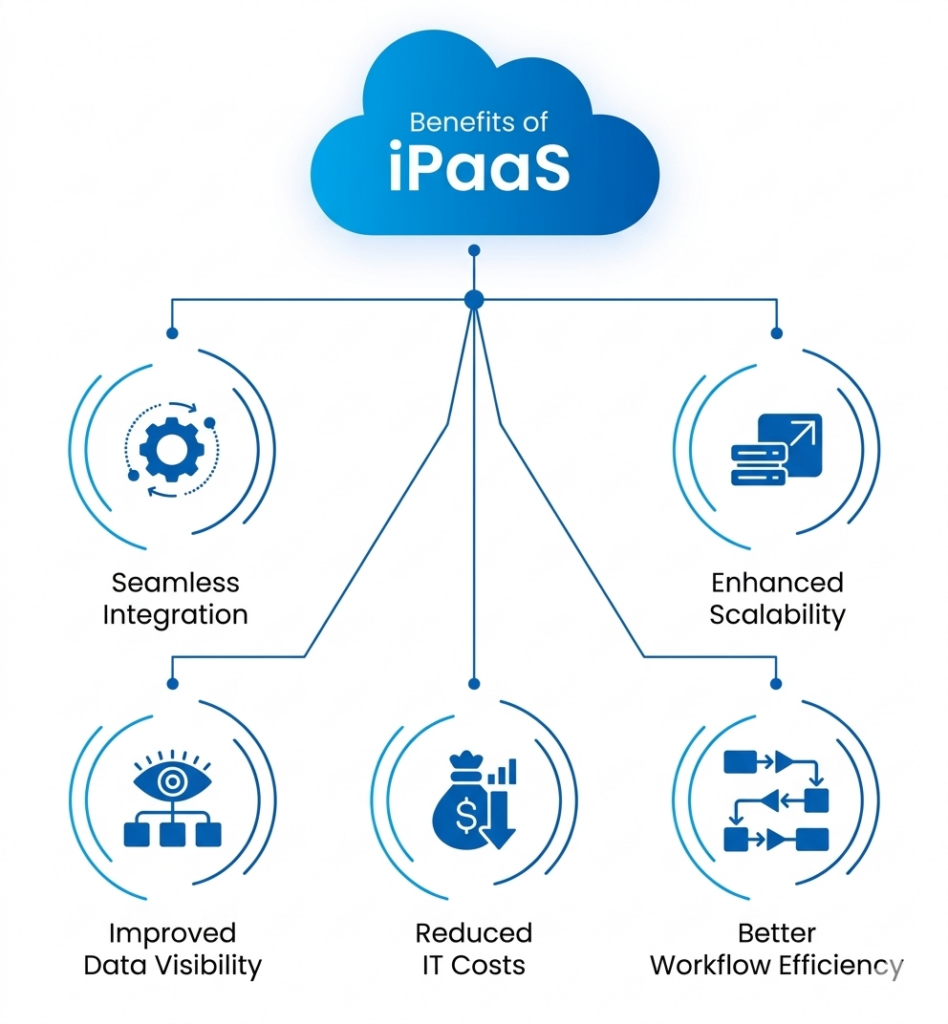
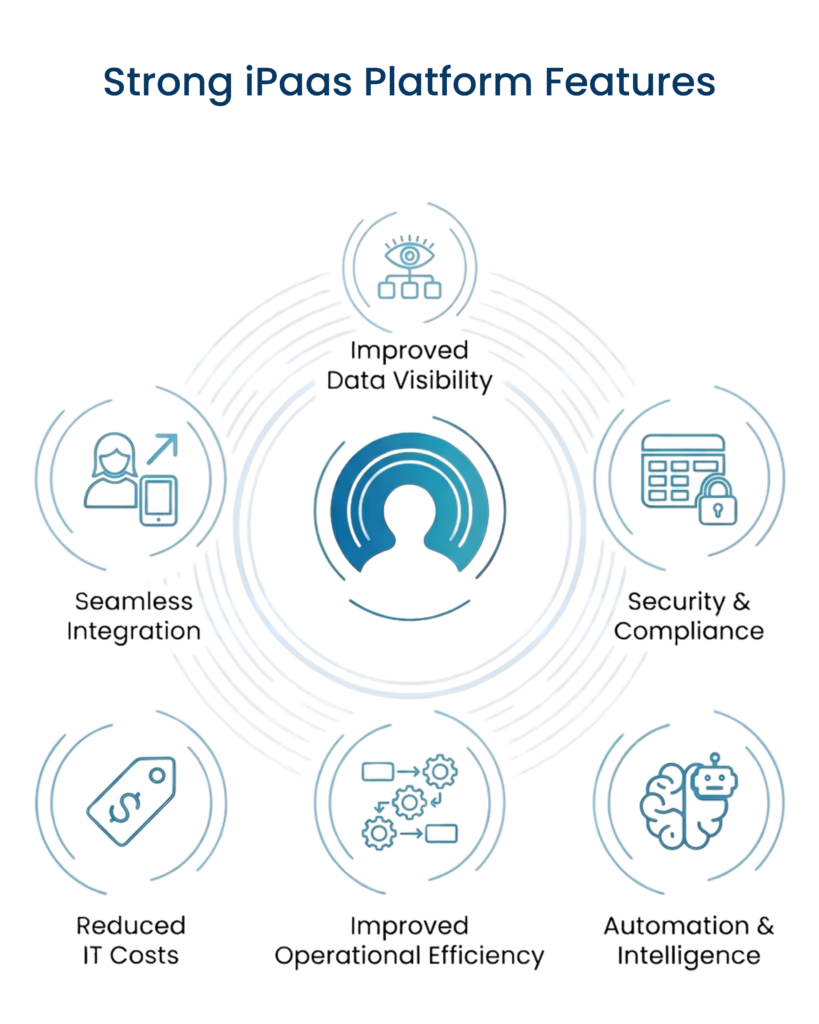
Why Comparing iPaaS Platforms Matters
Before investing in an iPaaS, taking time to compare options helps ensure the solution fits your business needs and solves real challenges. Here’s what to look at:
Customization: Each platform offers different levels of flexibility. Some let you tailor integrations closely to your workflows, while others are more rigid.
Integration Capabilities: The ability to connect with a wide range of systems and automate processes varies. Comparing platforms shows which one can handle the most connections smoothly.
Cost: Pricing models can be tricky. Looking at multiple platforms helps you understand not just license fees, but hidden costs like scaling, training, or support.
Performance: Speed, scalability, and reliability matter. A platform that integrates quickly and scales easily will save headaches as your business grows.
Security: Strong security features are essential to protect sensitive business and customer data. Comparing platforms ensures compliance with industry standards and regulations.
By comparing platforms carefully, businesses can pick the one that delivers efficient, secure, and reliable integrations.
MuleSoft
MuleSoft is an enterprise‑grade iPaaS and API management platform that connects applications, data, and services across organizations. It is built on an API‑led approach, where integrations are designed as reusable APIs to scale across teams and projects.
Its key strength is API‑led composability, allowing backend systems to be exposed as reusable APIs. This enables teams to reuse integration blocks across multiple applications, reducing duplication and speeding up delivery.
Other features include full API lifecycle management (API Manager), a connector library (300+ connectors), DataWeave for data transformation, Anypoint Studio for visual flow design, Anypoint Exchange for reusable assets, analytics and policy controls, and flexible runtimes via CloudHub or Runtime Fabric.
Connectors
500+ Snaps for Salesforce, NetSuite, Workday, Snowflake, AWS, SAP HANA, Microsoft Dynamics 365, Google Workspace, Stripe, Shopify.
Pricing
Subscription model based on nodes/pipelines, scaling with data volume. Free trial available.
Deployment options
SaaS via SnapLogic Cloud, with Groundplex for on‑prem connectivity while execution remains cloud‑hosted.
Best for
Mid‑to‑large enterprises with data teams needing visual ETL/ELT, hybrid data movement, and analytics pipelines. Strong for marketing data unification, cloud migration, and BI preparation.
Pros
- Easy‑to‑use integration wizard
- Transparent pricing with marketplace presence
- Early adoption of generative AI via SnapGPT
Cons
- Limited B2B integration features
- Restricted access permissions
- Steeper learning curve for advanced debugging
SnapLogic
SnapLogic is a cloud-based iPaaS and agentic AI platform built for data integration, pipeline automation, and governed AI agent deployment. It allows organizations to connect applications, databases, and analytics tools using visual “Snaps” (pre-built connectors), making it accessible for both technical and business teams
A key capability is its AI-powered pipeline design, extended in 2025-2026 with AgentCreator and SnapGPT for building and governing AI agents, plus native Model Context Protocol (MCP) support for secure AI agent access to enterprise data.
Other features include drag‑and‑drop pipeline creation, real‑time data synchronization, enterprise‑grade security (SOC2, HIPAA, RBAC), API management, GenAI/LLM connectors, and scalability to millions of tasks monthly.
Connectors
1,000 Snaps for Salesforce, NetSuite, Workday, Snowflake, AWS, SAP HANA, Microsoft Dynamics 365, Google Workspace, Stripe, Shopify.
Pricing
Subscription model based on nodes/pipelines, scaling with data volume.
Deployment options
SaaS via SnapLogic Cloud, with Groundplex for on‑prem connectivity while execution remains cloud‑hosted.
Best for
Mid-to-large enterprises needing visual ETL/ELT, hybrid data movement, analytics pipelines, and governed agentic AI workflows. Strong for marketing data unification, cloud migration, BI preparation, and enterprise AI agent orchestration.
Pros
- Intuitive visual pipeline builder with AI-assisted design
- Transparent pricing with marketplace presence
- Native MCP support for governed AI agent access to enterprise systems
Cons
- Limited B2B integration features
- Restricted access permissions
- Steeper learning curve for advanced debugging
Workato
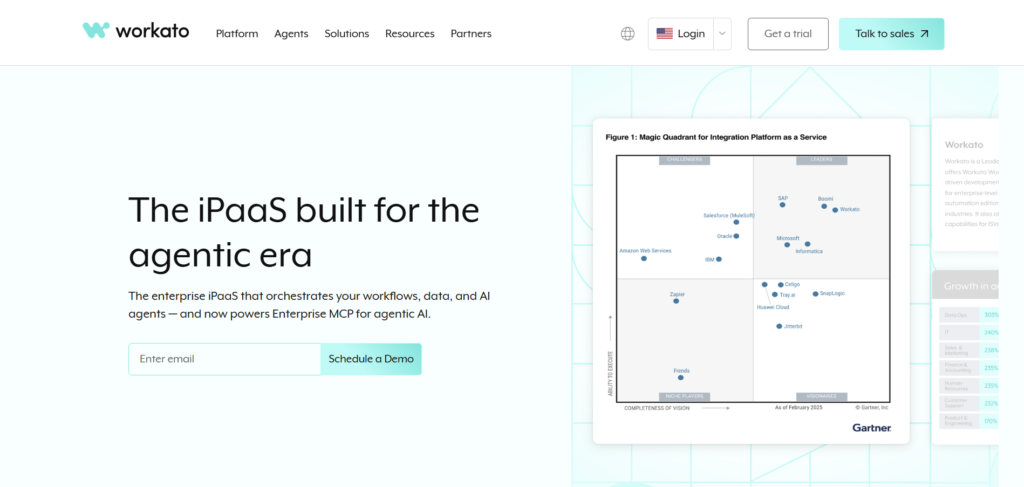
Workato is a cloud‑based iPaaS and automation platform hosted on AWS. It helps enterprises connect applications and automate workflows using low‑code/no‑code recipes, designed for both IT and business teams to build integrations quickly.
Its standout capability is smart automation with AI‑powered decision workflows. These workflows not only move data but also handle intelligent actions such as approvals, routing, and exception management.
Other features include a drag‑and‑drop recipe builder, real‑time synchronization, enterprise‑level security (RBAC, encryption, SOC 2/GDPR/HIPAA compliance), pre‑built templates for HR, Finance, and Marketing, API management, B2B/EDI support, and scalability for millions of tasks monthly.
Integrations
1,000+ apps including Salesforce, Slack, ServiceNow, Workday, SAP S/4HANA, Oracle NetSuite, Microsoft Dynamics 365, Marketo, Stripe, Shopify, and AWS services like S3, Lambda, Redshift, SQS/SNS, Bedrock. On‑prem connectivity supported via Intelligent Agent.
Pricing
Custom pricing based on license and usage. Costs vary by task volume, connectors, and features. Free trial available.
Deployment options
Fully SaaS (Workato‑hosted), with optional on‑prem agent for internal connectivity while execution remains in Workato’s cloud.
Best for
Mid‑to‑large enterprises needing fast automation across IT and business teams. Strong for DevOps, marketing ops, finance ops, HR, and cross‑functional workflows.
Pros
- User‑friendly interface with AI guidance
- Extensive connector and template library
- Detailed access control options
Cons
- Pricing can escalate with added processes
- Limited built‑in support for EDI/B2B features
- Reliance on AWS infrastructure
Boomi
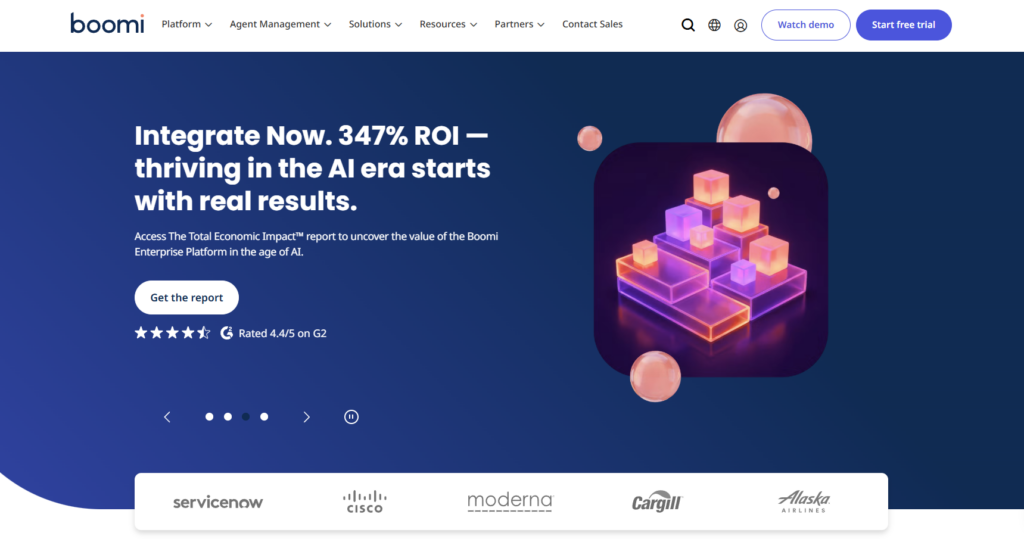
Boomi is a cloud‑native, low‑code iPaaS platform recognized for quick integrations and a simple drag‑and‑drop interface. It runs workflows on lightweight runtime engines called Atoms, which can be deployed in the cloud or on‑premises, making it effective for hybrid integration.
Its standout feature is its extensive connector ecosystem with 1,500+ prebuilt connectors, enabling rapid integration of enterprise applications without heavy custom development.
Other capabilities include low‑code integration flows, API development and management, event‑driven processing, Master Data Hub (MDM), workflow automation through Boomi Flow, built‑in monitoring and analytics, secure managed file transfer, and AI‑powered mapping suggestions to speed up pipeline creation.
Connectors
Salesforce, SAP, Oracle, NetSuite, Workday, ServiceNow, AWS, Azure, Google Cloud, SQL Server, PostgreSQL, Oracle, and many other enterprise systems.
Pricing
SaaS subscription. Pay‑as‑you‑go starts at $99/month plus usage. Professional and enterprise tiers are custom‑quoted, often scaling into tens of thousands annually depending on features and data volume.
Deployment options
Cloud‑managed, with execution handled through Atoms installed on‑premises or in any cloud. Provides hybrid setup with centralized control and local connectivity.
Best for
Small to large enterprises seeking fast, low‑code integrations. Useful for teams combining IT developers and business users. Common use cases include CRM‑ERP synchronization, data migration, API enablement, and hybrid workflows.
Pros
- Supports hybrid integration patterns, including ESB‑style setups
- Quick to get started with low‑code tools
- Large library of prebuilt connectors
Cons
- Pricing can be complex at scale
- Monitoring capabilities are less extensive than some competitors
- Advanced configurations may be challenging for users
iPaaS Platform Comparison Table
| Feature | Boomi | MuleSoft | SnapLogic | Workato |
|---|---|---|---|---|
| Primary Focus | iPaaS-native API-led integration & automation | API-driven developer-centric enterprise integration | Visual pipeline data integration | Workflow & no/low-code business automation |
| API Management | Strong (API Gateway, policies) | Industry leader (Anypoint Exchange, governance) | Moderate | Limited |
| Workflow Automation | Boomi Flow (strong) | Moderate (via APIs) | Limited | Industry leader (recipes) |
| Connectors | Large library (400+) | Enterprise-grade (Salesforce owned) | Extensive Snap Pack (1000+ SaaS) | 1000+ SaaS connectors |
| Scalability | Mid to large enterprise | Very high (global enterprise) | Cloud & hybrid (mid to enterprise) | Mid-enterprise (automation focus) |
| Deployment | Cloud + hybrid Atoms | Cloud, hybrid, on-prem | Cloud + hybrid | Cloud-native |
| Best Use Case | Hybrid & automation | Complex enterprise API landscapes | Fast data pipelines | Business process automation |
| Learning Curve | Moderate | Steep (developer focus) | Visual (low-moderate) | Lowest (recipes) |