
Salesforce’s TrailblazerDX 2026 kicks off April 15 in San Francisco. The conference is built entirely around one thesis: we’re entering the era of the Agentic Enterprise.
After watching Agentforce evolve through four major iterations in twelve months — from the initial launch in October 2024, through Agentforce 2, 2dx, 3, and now Agentforce 360 — the pace alone signals something worth paying close attention to. This isn’t incremental. Salesforce is rebuilding the architectural foundation of its entire platform around autonomous agents.
But here’s the lens I want to bring to this, the same one from my earlier piece on the space between platforms: what does Agentforce 360 mean for enterprises that don’t run Salesforce alone?
Because that’s most enterprises. They run Salesforce AND MuleSoft AND Workato AND Claude AND Shopify or SAP or NetSuite. Each selected for good reasons. Each now building agents of its own.
Agentforce 360 is the most comprehensive attempt by any single platform to solve the multi-agent enterprise problem. Understanding what it does well — and where the open questions remain — matters for anyone making deployment decisions right now.
What Agentforce 360 Actually Is
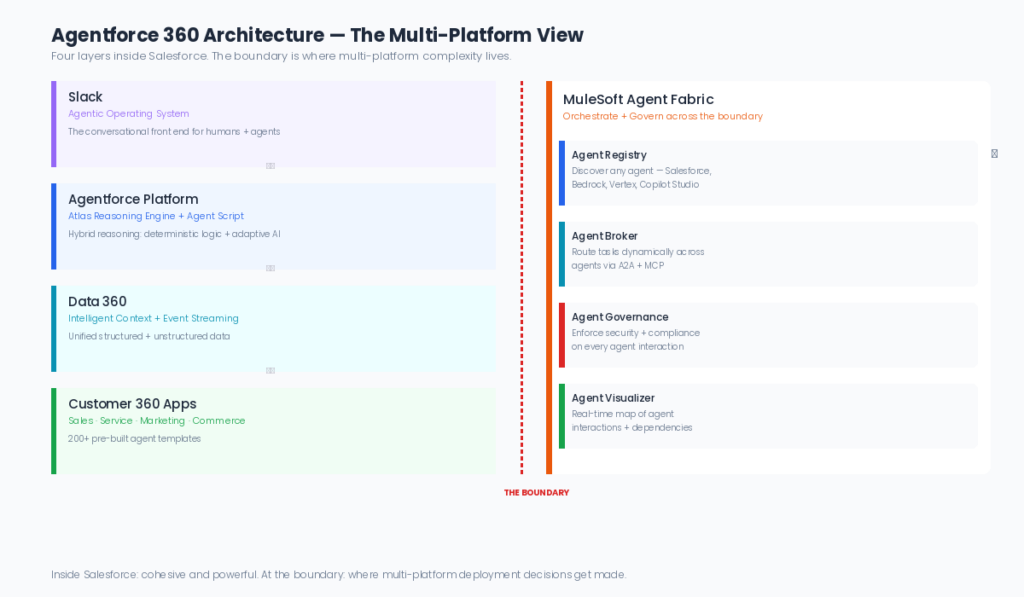
Agentforce 360 isn’t a product. It’s a re-architecture. Constellation Research describes it as Salesforce’s bid to orchestrate first and third-party AI agents across the entire enterprise. The stack is unified into four layers:
Agentforce Platform — the runtime and reasoning layer. The Atlas Reasoning Engine now supports hybrid reasoning — combining deterministic logic (Agent Script) with adaptive AI from multiple model providers including OpenAI, Anthropic, and Google Gemini. Agent Script is a human-readable JSON expression language that lets teams define if/then logic, guardrails, and handoff rules so agents behave predictably while still leveraging LLM creativity where appropriate.
Data 360 (formerly Data Cloud) — the context layer. Data 360 unifies structured and unstructured data, resolves identities across sources, streams events in real time, and powers Intelligent Context — the ability to extract, structure, and surface complex business data so agents don’t hallucinate. Salesforce was recently named a leader in the 2026 Gartner Magic Quadrant for Customer Data Platforms.
Customer 360 Apps — the business logic layer. Sales, Service, Marketing, Commerce — with over 200 pre-built agent templates, topics, and actions available out of the box. This is where Salesforce’s 25 years of CRM domain knowledge gives Agentforce a genuine advantage.
Slack — the collaboration front end. Parker Harris called Slack “the front end of Salesforce.” It’s being repositioned as the Agentic Operating System where humans and agents work together.
Each layer builds on the one below it. The architecture is genuinely cohesive within the Salesforce ecosystem. But the keyword there is “within.”
Where It Crosses the Boundary: MuleSoft Agent Fabric
Salesforce clearly recognizes that agents can’t live inside Salesforce alone. That’s why MuleSoft Agent Fabric exists — and it’s arguably the most strategically important piece of the Agentforce 360 story for multi-platform enterprises.
Agent Fabric has four components:
Agent Registry — a central catalog where any AI agent, MCP server, or A2A-compliant tool can be registered and made discoverable. Not just Salesforce agents. Any agent. This includes agents built on Amazon Bedrock, Google Vertex AI, and Microsoft Copilot Studio. Agent Scanners can automatically detect and register agents running across these ecosystems.
Agent Broker — an intelligent routing service that organizes agents into business-focused domains and dynamically routes tasks across them. Powered by the LLM of your choice, connected through A2A and MCP protocols.
Agent Governance — enterprise-grade guardrails using Flex Gateway to enforce security, compliance, and policy controls on every agent interaction.
Agent Visualizer — a real-time map of agent interactions, decision flows, and dependencies.
This is genuinely impressive. MuleSoft Agent Fabric is the most mature attempt I’ve seen to solve agent orchestration and governance across platforms. It supports A2A and MCP protocols and is designed to be ecosystem-agnostic by architecture.
The Questions That Remain
Acknowledging what Agentforce 360 does well doesn’t mean the multi-platform deployment problem is solved.
The data truth problem hasn’t gone away. Data 360 is powerful for unifying data into Salesforce’s context layer. But when an Agentforce agent needs to reconcile its view of a customer with what the ERP says, or what Claude has synthesized from contract documents — those definitions still diverge. Data 360 unifies data into Salesforce. The question is what happens at the boundary where Salesforce’s definition meets everyone else’s.
Agent Script controls Agentforce agents. Who controls the rest? Agent Script gives teams deterministic control over how Agentforce agents behave. But when an Agentforce agent triggers a Workato Genie, or passes context to Claude, those agents have their own reasoning engines, their own guardrails, and their own authority models.
Observability ends at the platform edge. Agent Visualizer maps agent interactions within the MuleSoft-governed network. But many enterprises have agents running in environments that aren’t yet registered in Agent Registry — custom Python agents, department-level GPT wrappers, point-solution AI tools.
The Informatica acquisition changes the data picture. When fully integrated, Informatica’s data catalog and governance capabilities will feed into Data 360 — potentially strengthening the cross-platform data governance story significantly.
MCP and A2A are early. Agent Fabric’s support for these protocols is architecturally correct. But real-world behavior of agents negotiating across these protocols in production enterprise environments is largely untested at scale.
What to Watch at TDX 2026
For anyone watching TDX through a multi-platform lens — whether attending in San Francisco or streaming on Salesforce+:
The Agentforce 360 keynote (April 15, 10:00 AM PT) — listen for how Salesforce talks about agents crossing boundaries. The tell is how much time they spend on the interoperability story.
True to the Core (April 15, 1:30 PM PT) — the unscripted Q&A with Salesforce product leaders. If you could ask one question: “When an Agentforce agent triggers a third-party agent via MuleSoft Agent Broker, and the third-party agent takes an action that needs to be rolled back, how does the failure cascade work?”
Agent Fabric deep-dive sessions — particularly sessions covering real production implementations where agents from different platforms are coordinated.
Agentforce City — look for enterprises running Agentforce alongside non-Salesforce agents. The implementation details from these stories are where the practical learning lives.
The Hackathon Showdown (April 15, 3:00 PM PT) — watch for teams that built solutions crossing platform boundaries.
A Practical Framework: Multi-Agent Maturity
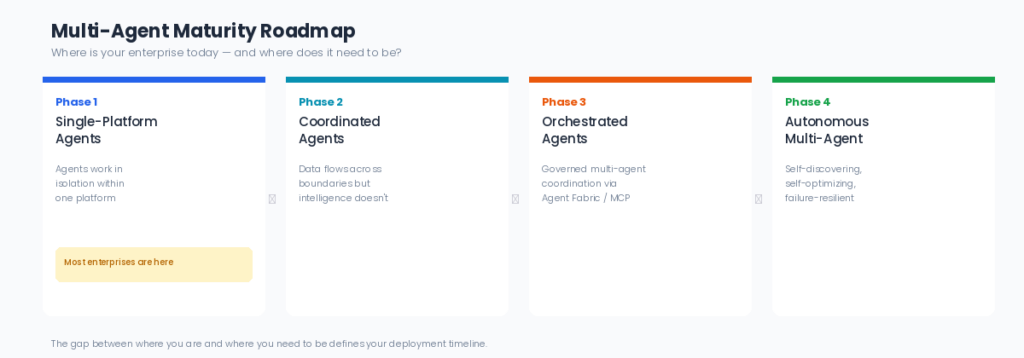
Whether or not you’re watching TDX, here’s a framework for thinking about where your enterprise sits:
Phase 1: Single-Platform Agents. Agents operating within one platform in isolation. Agentforce handling service cases. Claude summarizing documents. This is where most enterprises are today.
Phase 2: Coordinated Agents. Agents that pass data across boundaries but don’t make cross-platform decisions. Data flows, but intelligence doesn’t.
Phase 3: Orchestrated Agents. Agents that are aware of each other, coordinate through a governance layer like MuleSoft Agent Fabric, and can negotiate across platform boundaries.
Phase 4: Autonomous Multi-Agent Systems. Agents that discover new agents, form ad-hoc collaborations, and handle failure cascades without human intervention. Nobody is fully here yet.
The question for your enterprise: which phase are you in, which phase do you need to be in, and what’s the gap?
The Numbers Behind the Momentum
The scale of Agentforce adoption is worth noting. Salesforce’s FY26 results show Agentforce and Data 360 ARR reached $2.9 billion (up 200% year-over-year), with Agentforce-specific ARR hitting $800 million (up 169% YoY). Over 29,000 Agentforce deals have closed since launch, up 50% quarter-over-quarter, with accounts in production increasing nearly 50% in Q4 alone.
The 2026 Connectivity Benchmark Report from Salesforce found that organizations currently use an average of 12 agents, with that number projected to climb 67% within two years. But 50% of those agents currently operate in isolated silos — reinforcing the multi-platform orchestration challenge that Agent Fabric is designed to address.
Looking Forward
Agentforce 360 represents a genuine architectural leap. Salesforce has moved from “we have agents” to “we have a unified platform for the agentic enterprise” faster than most observers expected. MuleSoft Agent Fabric extends that story beyond Salesforce’s walls in a way that’s architecturally sound and standards-based.
For multi-platform enterprises, this creates both opportunity and homework. The opportunity is that governance and orchestration infrastructure is maturing. The homework is that the infrastructure only works if your enterprise is ready for it — clean APIs, governed data, documented agent authority levels, defined trust boundaries, failure recovery plans.
I’ll be watching TDX closely and will share observations on what the announcements mean for multi-platform deployments. More to come on this. If you’re navigating something similar, let’s talk.
This article is part of Incepta’s Release Intelligence series — tracking what matters across Salesforce, MuleSoft, Workato, Anthropic, and Shopify for multi-platform enterprises. For a deeper look at the multi-platform challenge, read The Space Between Platforms on LinkedIn.
Sources & References
- Salesforce — Agentforce 360 Announcements
- Salesforce — MuleSoft Agent Fabric Announcement
- Salesforce — Agentforce 360 Platform
- Constellation Research — Salesforce makes its Agentforce 360 case
- Salesforce Ben — 4 Critical Features for Agentforce Architecture in 2026
- Salesforce — 2026 Connectivity Benchmark Report
- ERP Today — Agentforce Tour NYC Keynote
- Salesforce Architects — MuleSoft Agent Fabric Deep Dive
- TDX 2026 — Official Event Page

Parth leads Incepta's Center of Excellence across Salesforce, MuleSoft, Workato, Shopify, and enterprise AI — helping organizations build the governed integration architectures that power production-grade agentic systems. With deep expertise spanning CRM strategy, enterprise commerce, data architecture, and multi-platform integration, Parth works directly with technology leaders navigating the convergence of AI agents, cloud platforms, and digital transformation.