
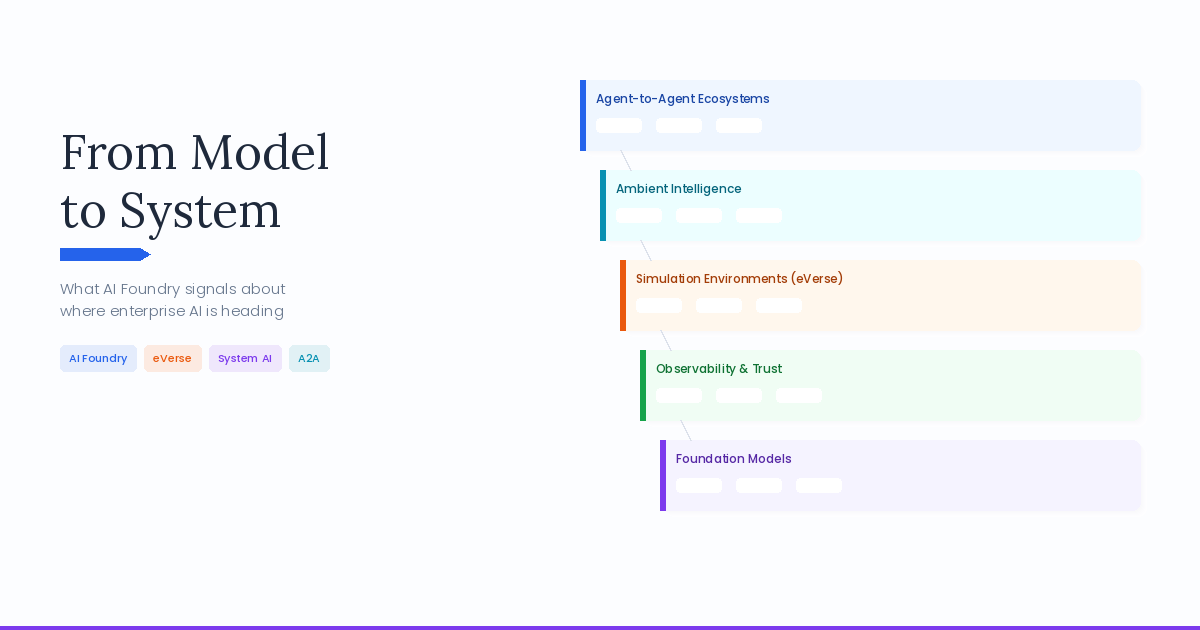
On March 26, Salesforce AI Research announced AI Foundry — and buried in what could have been a routine research initiative announcement is arguably the most important strategic signal Salesforce has sent this year.
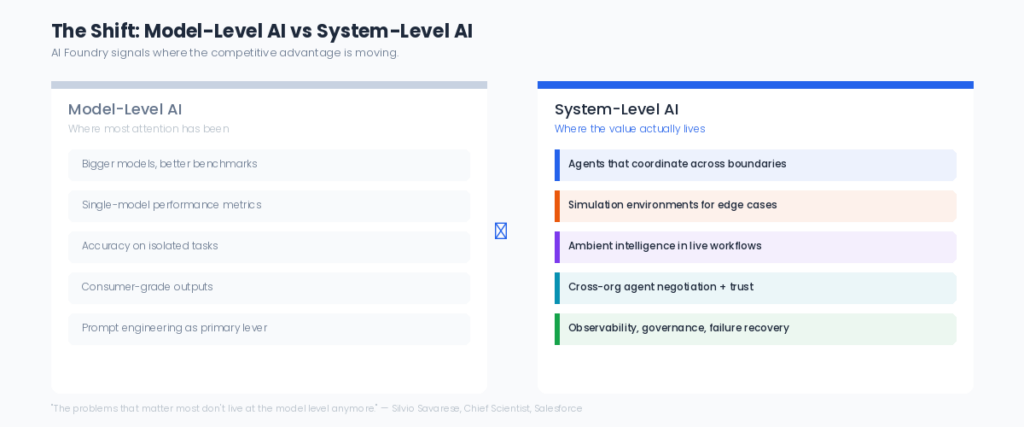
The signal: the competitive advantage in enterprise AI has moved from model performance to system orchestration.
Silvio Savarese, Salesforce’s Chief Scientist, put it directly: “The problems that matter most for businesses don’t live at the model level anymore. They live at the system level, where components work together to deliver accuracy, consistency, and reliability at scale.”
This is a fundamental shift. For a decade, AI progress meant better models — bigger, faster, more capable. Salesforce contributed to that progression, from predictive AI (Moirai) to generative AI (Agentforce for Developers) to agentic AI (Agentforce). But as large language models mature and approach commodity status, the gap between what a model can do in isolation and what a system needs to deliver in production has become the central challenge.
AI Foundry is Salesforce’s answer. And understanding what it’s building — and what it means for multi-platform enterprises — matters for anyone making architectural decisions right now.
Three Pillars: Where AI Foundry Is Investing
AI Foundry brings together AI research, strategic customers, and academic partners around three areas where Salesforce sees the greatest opportunity for enterprise impact.
Pillar 1: Simulation Environments — Agents That Learn from Experience
AI Foundry has built eVerse, a simulation environment that exposes agents to thousands of edge cases, handoffs, and judgment calls before they reach production. This is directly connected to the Agent Development Lifecycle (ADLC) we wrote about earlier this week — you can’t measure agent competency without realistic test conditions.
eVerse has already been used to stress-test Agentforce Voice across thousands of simulated conversations and to pilot UCSF Health’s contact center billing agents. The environment generates realistic business conditions at scale — noisy backgrounds, distracted callers, complex multi-step processes — so agents face the full range of situations they’ll encounter in production.
For multi-platform enterprises, the question is: who builds the simulation environment for cross-platform agent chains? eVerse tests agents within Salesforce’s ecosystem. When your workflow crosses Salesforce, MuleSoft, Workato, and Claude, the edge cases multiply at every boundary. An agent that handles a UCSF billing scenario perfectly inside Salesforce may behave differently when the billing data comes from an ERP through MuleSoft and the patient context was synthesized by Claude.
Pillar 2: Ambient Intelligence — Agents That Disappear Into the Environment
This is the pillar that will have the most visible impact on how enterprise workers experience AI. Ambient intelligence is context-aware, proactive, and timely. It understands the full situation, anticipates needs before they emerge, and surfaces just-in-time insights — without creating information overload.
AI Foundry is developing a Proactive In-Meeting Support Agent (PISA), a sales assistant with access to CRM data that sits in on sales meetings and surfaces insights as needed. The research focus is deliberately on human-AI interaction patterns — AI that’s always on but never overwhelming.
The practical significance: this is the evolution from agents you invoke to agents that simply work alongside you. The UX challenge is enormous. Too proactive and the agent becomes noise. Too passive and it adds no value. Getting this balance right is a design problem as much as a technical one.
For multi-platform environments, ambient intelligence needs context from every system the worker uses. A sales meeting agent that only sees CRM data misses the ERP invoice history, the contract details in DocuSign, and the support ticket escalations in ServiceNow. Ambient intelligence that’s truly useful requires the cross-platform data integration that makes the context complete.
Pillar 3: Agent-to-Agent Ecosystems — Agents That Interact Across Organizations
This is the pillar with the deepest implications. AI Foundry has developed protocols like agent cards and is building an enterprise multi-agent semantic layer with standardized protocols, guardrails, decision logging, and coordinated escalation.
The critical detail: Salesforce is working with its legal counsel and Office of Ethical Use of Technology to define legal frameworks for autonomous agent negotiation. When Agent A from Company X negotiates with Agent B from Company Y, what are the rules? Who’s liable? How are disputes resolved?
Itai Asseo, VP of Salesforce AI Research, framed it: “We soon will have personal agents, and local agents will be interacting with business agents. We’re going to need to go a step further by not only looking at how two agents will interact at the protocol level, but also at the semantic level.”
This is where MuleSoft Agent Fabric and the A2A/MCP protocol ecosystem become essential infrastructure. The protocols exist for how agents discover and communicate with each other. The semantic layer — shared understanding of what entities mean, what actions are authorized, what outcomes are acceptable — is still being defined.
Why the Model-to-System Shift Matters for Multi-Platform Enterprises
The shift from model-level to system-level AI validates something we’ve been seeing across deployments: the hardest problems aren’t about making individual agents smarter. They’re about making the system of agents work together reliably.
This plays out in three concrete ways:
Reliability at the boundary. A model that scores 95% on benchmarks can still fail at the boundary between two platforms where data definitions diverge, permissions reset, and observability gaps emerge. System-level reliability means reliability across the full agent chain, not just within each component.
Trust that spans platforms. The eight design principles Salesforce published for the Agentic Enterprise include “build with trust” and “unified observability.” These principles work well within one ecosystem. At the system level — where the system includes Salesforce, MuleSoft, Workato, Anthropic, and your ERP — trust requires governance that no single platform can provide alone.
Simulation that reflects reality. eVerse is a breakthrough for testing agents within Salesforce. But enterprise reality includes agents crossing four platforms in three seconds. The simulation environment that matters most is the one that tests the chain, not just the agents. This may be the most significant gap in the current tooling landscape — and the most significant opportunity.
What AI Foundry Means for TDX 2026
TDX 2026 starts April 15. AI Foundry was announced two weeks before the conference — not at it. That’s deliberate. Salesforce is setting the conceptual frame before the product announcements.
At TDX, watch for:
eVerse in practice. Expect demos showing how simulation environments train agents before production. The question to ask: does this extend to agents that operate across MuleSoft-governed boundaries?
Agent cards and semantic layer details. AI Foundry mentioned agent cards and a multi-agent semantic layer. TDX should reveal how these translate into product capabilities inside Agent Fabric and Agentforce.
Ambient intelligence demos. PISA (the in-meeting sales agent) may make an appearance. Watch for whether the context it draws from extends beyond Salesforce CRM data.
Legal frameworks for agent negotiation. This is the most forward-looking aspect of AI Foundry. Any TDX session that touches on cross-organization agent interaction is worth prioritizing.
A Practical Question for Your Architecture
AI Foundry’s thesis is clear: the competitive advantage has moved from model performance to system orchestration. If you accept that thesis — and the evidence is compelling — the question becomes: is your architecture designed for system-level AI, or is it still optimized for model-level thinking?
System-level thinking means your agents can be tested against realistic conditions before production — including cross-platform edge cases. It means your AI surfaces context proactively from every system the worker uses, not just one. It means your agents can discover and coordinate with other agents through governed protocols. And it means your governance model spans every platform boundary, not just the ones inside a single ecosystem.
The organizations that are furthest along on this journey are the ones that invested in clean integration architecture before the AI wave arrived. Their APIs are documented. Their data is governed. Their identity management spans platforms. They didn’t know they were building the foundation for system-level AI — but they were.
For everyone else, the work starts with understanding where you are. The interactive diagnostic above maps your readiness against AI Foundry’s three pillars plus boundary governance. It’s a starting point, not a destination.
More to come as TDX unfolds. If this resonates with what you’re seeing in your own deployments, I’d welcome the conversation.
This article is part of Incepta’s Release Intelligence series. For related analysis, see Salesforce’s $120M Agent and the ADLC, Agentforce 360 and the Multi-Platform Reality, and The Space Between Platforms on LinkedIn.
Sources & References
- Salesforce AI Research — AI Foundry Announcement
- Salesforce — eVerse Simulation Environment
- Salesforce — Agent Interoperability and Agent Cards
- Salesforce — Agent-to-Agent Interaction
- Salesforce — 8 Design Principles for the Agentic Enterprise
- Salesforce — Applied AI: Lessons from Building Agents in the Enterprise
- CIO.com — Salesforce AI Research Identifies Trends Shaping Agentic AI
- Diginomica — The Big Bets: Model to System Level AI
- Salesforce — 2026 Connectivity Benchmark Report

Parth leads Incepta's Center of Excellence across Salesforce, MuleSoft, Workato, Shopify, and enterprise AI — helping organizations build the governed integration architectures that power production-grade agentic systems. With deep expertise spanning CRM strategy, enterprise commerce, data architecture, and multi-platform integration, Parth works directly with technology leaders navigating the convergence of AI agents, cloud platforms, and digital transformation.