
Choosing between MuleSoft and SnapLogic comes down to one question. What job do you need the platform to do? The answer, not the feature list, should drive the pick.
SnapLogic fits teams that want fast, low-code data integration with help from AI. It works well when your technical team is small. While MuleSoft fits organizations that need a governed API backbone, deep control over every API, and tight links to Salesforce.
Neither platform is cheap. The MuleSoft vs. SnapLogic choice rarely turns on a single feature. It turns on the work in front of you.
iPaaS means integration platform as a service. It is a tool that connects your apps and data without hand-coding every link. Because we implement both, the way we scope an integration platform decision starts with the job, not the brand.
If you’re comparing MuleSoft versus SnapLogic, we’ll go through an honest perspective on implementing both solutions, as well as key considerations you should look out for if you’re contemplating which solution to use.
How we look at this as a firm that implements both
Most SnapLogic vs. MuleSoft articles are written by someone selling one platform, or selling a third one. Ours is not. Incepta has been a MuleSoft Premier Partner since 2017, and our MuleSoft delivery team has shipped complex API work for years.
We also run a SnapLogic practice, plus Boomi and Workato practices. Because we deliver across more than one platform, we can tell you when to pick each, when to run more than one, and when to pick neither. That is the promise of this comparison, and the rest of the page keeps it.
What is SnapLogic?
SnapLogic is a cloud-native iPaaS built for fast, low-code data integration and app integration. You build a workflow by dragging pre-built connectors onto a visual canvas. That is why standing up SnapLogic pipelines for clients often moves quicker than a code-first build.
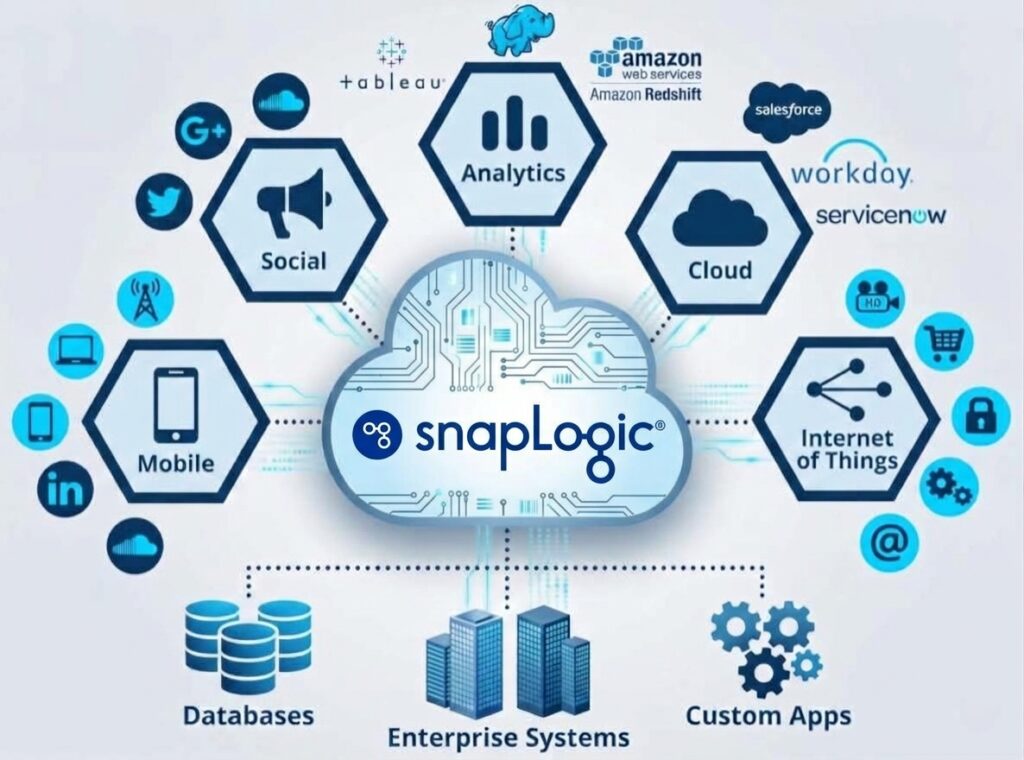
Two words sound alike but mean different things. A Snap is one pre-built connector or action, like “read from Salesforce.” A Snaplex is the engine that runs the whole pipeline. Snaps are the parts. The Snaplex is the motor.
The Snaplex is elastic, which means it scales up and down as traffic changes. It comes in two forms, and both are types of Snaplex, not separate products. A Cloudplex is hosted and managed by SnapLogic. A Groundplex runs behind your own firewall for on-premises systems.
Most enterprises run both together in a hybrid setup. This keeps cloud work fast while sensitive data stays in-house.
SnapLogic also leans hard into AI. SnapGPT builds pipelines from plain-language prompts, and AgentCreator, added in late 2024, builds no-code AI agents. The platform ships more than 1,000 pre-built Snaps, and it was founded in 2006 by a former Informatica co-founder. It fits teams that want speed and accessibility without a large specialist bench.
What is MuleSoft?
MuleSoft is an iPaaS and API platform built around API-led connectivity. That is a way of exposing every system as a reusable, governed API. Its core product is the Anypoint Platform, where teams design, build, secure, and manage APIs across the business.
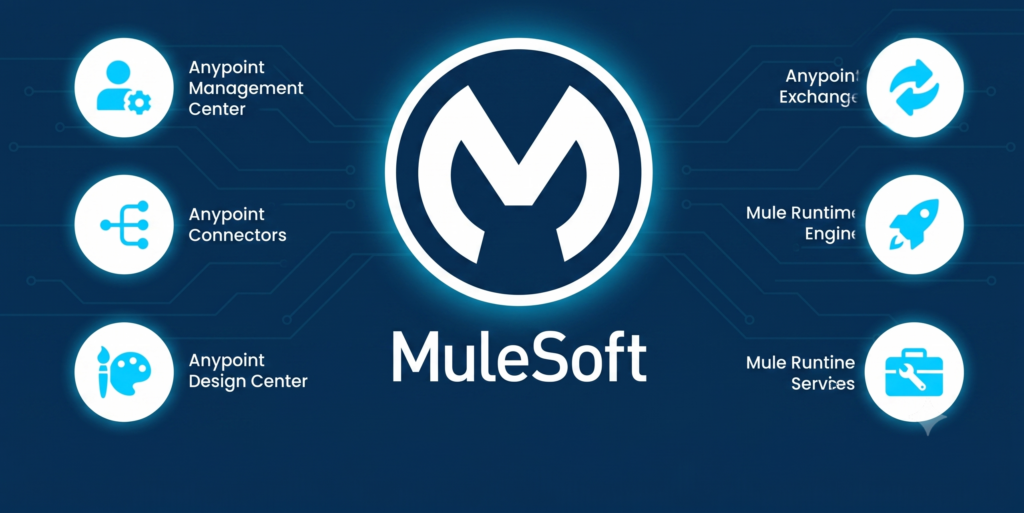
MuleSoft has roots in the older enterprise service bus world, a Java-based way to wire systems together. It is not legacy middleware today. It is a full integration platform and API-management suite, and a structured read on your current Anypoint setup usually starts there.
Developers reshape data with DataWeave, MuleSoft’s own transformation language, inside a tool called Anypoint Studio. Runtimes include CloudHub and Runtime Fabric, so pipelines can run in the cloud or behind your firewall. Salesforce bought MuleSoft in 2018 for about $6.5 billion, so it ties tightly into the Salesforce and Agentforce world.
MuleSoft carries around 300 to 420 connectors, plus a software kit for building custom ones. Complex rollouts often take three to six months. It fits organizations that need a governed API backbone and have, or will build, a skilled developer team.
MuleSoft vs. SnapLogic Comparison
The differences in the MuleSoft vs. SnapLogic comparison are more about philosophy than raw capability. SnapLogic leans toward speed and low-code access. MuleSoft leans toward governance and full API control. Both connect almost anything to almost anything.
The table below sums up how they compare. For the wider shortlist, the platform choices we walk clients through go beyond just these two.
| Capability | SnapLogic | MuleSoft |
| Primary strength | Fast low-code data pipelines, AI-assisted | Governed API-led connectivity, full API lifecycle |
| Typical user | Analysts and integrators, smaller specialist bench | Professional developers, API architects |
| Build style | Drag-and-drop Snaps plus SnapGPT prompts | DataWeave plus Anypoint Studio, developer-led |
| Connectors | 1,000 Snaps | ~300 to 420, plus a custom SDK |
| Runtime | Snaplex (Cloudplex plus Groundplex) | CloudHub plus Runtime Fabric |
| API management | Present, maturing rapidly with AI-agent governance additions | Comprehensive and mature |
| AI features | SnapGPT, AgentCreator, SnapCode, SnapLogic Intelligent Modernizer (SLIM), SnapLogic MCP Server, Enterprise MCP | Einstein and Agentforce connectors |
| Salesforce fit | Strong connector, not native | Native, since Salesforce owns MuleSoft |
One note on connector counts. MuleSoft calls them connectors, SnapLogic calls them Snaps, and the numbers are not apples-to-apples. A bigger count is not automatically better.
MuleSoft vs. SnapLogic : The Total Cost of Ownership
Here is the part no vendor page wants to show you. Both platforms are quote-based, and neither publishes a real price list. So we use procurement data to give you honest ranges, the same way we model the true cost of an Anypoint rollout before a client signs.
Procurement figures from Vendr put SnapLogic contracts from about $30,000 for small deployments to $300,000 or more for large ones. Its pricing is built from packages. Task volume, connectors, environments, support tier, and deployment model all move the number.
For MuleSoft, Vendr data reviewed by Costbench and CheckThat shows a median around $55,000 to $69,000 a year. The range runs from roughly $10,000 to $259,000, and large enterprises reach $250,000 to $600,000 or more. That puts MuleSoft pricing above both Workato and Boomi for similar work.
The license is only part of the bill. MuleSoft carries a staffing cost that surprises many buyers, because DataWeave developers are scarce. Industry salary data puts them at $150,000 to $200,000 each. First-year totals often run two to three times the base subscription.
SnapLogic’s lower-code style needs fewer specialists. But task and node-based scaling and premium connectors can add up at high volume. So the pricing gap can narrow once real usage grows.
| Cost item | SnapLogic | MuleSoft |
| Small or departmental | ~$30k and up | ~$10k to $55k |
| Mid-market median | Package-based quote | ~$55k to $69k |
| Large enterprise | Up to $300k+ | $250k to $600k+ |
| Pricing model | Quote-based packages | vCore or usage-based, plus add-ons |
| Specialist staffing | Smaller, lower-code bench | DataWeave devs $150k to $200k each |
When you compare quotes, look past the sticker. Add staffing and rollout to the license to see the total cost of ownership. That total, not the license line, is what your CFO will judge. In most builds, staffing and rollout cost more than the software itself.
Where Each Solution Comes Out Ahead
Based on independent reviews, here’s where each solutions comes out ahead.
SnapLogic comes out ahead on:
- Speed and low-code access, so non-specialists get productive fast
- AI-assisted building with SnapGPT
- Getting a small team shipping without a deep developer bench
- Flexible subscription pricing that reviewers on PeerSpot tend to like
MuleSoft comes out ahead on:
- API management, where G2 reviewers score it far ahead
- Exception handling, a common weak spot in fast builds
- Hybrid deployment strength across cloud and on-premises
- Native Salesforce depth, since Salesforce owns it
The two platforms also take different AI bets. SnapLogic builds agents with AgentCreator inside the pipeline. MuleSoft pushes work toward Agentforce and the Salesforce stack. When wiring agentic AI into a live integration layer, we pick based on where your CRM and data already live.
Analysts recognized SnapLogic as a Visionary in the 2026 iPaaS Magic Quadrant. MuleSoft holds a leader spot in API management. Both readings match what we see in the field.
The real split is simple. API management means governing and securing APIs across the business, which is MuleSoft’s core job. Data and app integration means moving and reshaping data fast, which is SnapLogic’s core job. The question is not which is better. It is which job you are hiring for.
The Five Jobs: How To Choose Between MuleSoft vs. SnapLogic
Let’s start from the job you need done. Most MuleSoft vs. SnapLogic decisions fall into one of five jobs, and each one points to a clearer answer.
Job 1: Build a governed API backbone
Better fit: MuleSoft.
When you need every system exposed as a secure, reusable API with full governance, API-led connectivity is the point. We built this for a public sector client, where an API platform we delivered for a new product launch connected a commerce front end to ERP, logistics, and payment systems.
The caveat: this job needs a skilled bench. Budget for the people, not just the license.
Job 2: Move and reshape data fast with a lean team
Better fit: SnapLogic.
When the goal is quick data integration and you do not have many specialists, low-code Snaps, SnapGPT, and the elastic Snaplex get you there faster. The caveat: watch task and node scaling costs as volume grows. Speed early can turn into a bigger bill later if no one is modeling usage.
Job 3: Modernize or migrate off a legacy runtime
Either platform, depending on your target.
Migrations are almost always harder than they look. We ran a flow-by-flow migration for a global spirits and wine brand, moving six integration sets to the current MuleSoft runtime while keeping business logic intact. The caveat: assess first. A clear effort estimate prevents a stalled project midway.
Job 4: Add AI or agentic automation
Both platforms bet on AI, but differently.
SnapLogic uses AgentCreator inside the pipeline. MuleSoft leans on the Salesforce and Agentforce stack. Choose by where your CRM and data sit, and by which team will own the agents. The caveat: AI features drive consumption, so they can push your next renewal higher.
Job 5: Consolidate a sprawl of point-to-point integrations
Either platform works, because the win here is architecture.
For an enterprise entertainment and gaming company, an assessment that cut integration complexity by nearly a third also delivered 40 percent faster project delivery through reusable APIs. The caveat: start with an assessment, not a license. Buying a platform before you understand the sprawl just moves the mess.
How To Decide On Which Solution?
If you want a shortcut through MuleSoft vs. SnapLogic question, ask four plain questions about your integration platform needs. The answers usually settle the shortlist.

First, who will build and run it? If you have API architects and developers, MuleSoft rewards that skill. If you have a lean team, SnapLogic’s low-code style fits better and gets people productive sooner.
Second, what is the core job? Governed APIs across the whole business point to MuleSoft. Fast data integration and pipelines point to SnapLogic.
Third, where does your data live? A Salesforce-heavy stack leans MuleSoft, since Salesforce owns it. A mixed cloud and warehouse stack often leans SnapLogic.
Fourth, what is your timeline and budget? SnapLogic tends to stand up faster and start at a lower price. MuleSoft asks for more time and more specialist pay, and it pays that back when strong governance is the goal.
Answer those four, and the right iPaaS usually becomes clear. When it does not, that is your sign to run a short assessment before you commit to either platform. A week of scoping beats a year of regret on the wrong platform.
When We Tell Clients to Pick Neither
Sometimes the honest answer is that neither MuleSoft nor SnapLogic is right. We say so when the job points elsewhere.
If the work is simple SaaS-to-SaaS workflow automation across business teams, Workato often fits better. For that job, drag-and-drop workflow automation can beat a heavy API platform.
If you need a very large connector library and a low-code hybrid runtime at a lower price, Boomi often wins. That is because the low-code option with the biggest connector library covers a lot of ground with less custom work.
Lock-in is worth naming too. MuleSoft’s DataWeave is proprietary, so switching cost climbs the longer you use it. SnapLogic’s task and node model can surprise at scale. Neither is a reason to avoid a platform. Both are reasons to match the platform to the job before you buy.
How Incepta Solutions Can Help With Your Decision
You are choosing between two strong platforms, and you do not need a vendor pitch. You need an experienced perspective on which one fits your job, your team, and your budget.
- Not sure which platform fits the job: we scope it against your real systems, not a feature list.
- Worried about true cost: we model license, staffing, and rollout together before you commit.
- In a regulated industry: we design for data residency and governance from day one.
When you are ready, book an integration platform assessment and we will help you settle the MuleSoft vs. SnapLogic decision, even if the answer turns out to be neither.
Frequently Asked Questions
Is SnapLogic better than MuleSoft?
Neither is better in every case. SnapLogic wins for fast, low-code data integration and small teams. MuleSoft wins for governed API-led connectivity and Salesforce-heavy stacks. The right pick depends on the job you need done, not on which vendor markets harder. Start from the work, then choose the platform.
What is the main difference between MuleSoft and SnapLogic?
The main difference is philosophy. MuleSoft is governance-first, with full API lifecycle control and deep Salesforce ties. SnapLogic is speed-first, with low-code Snaps and AI help. Both connect the same systems. Our head-to-head platform guide lays out the trade-offs in one view.
Which costs more, MuleSoft or SnapLogic?
Both are quote-based, so exact pricing varies. Procurement data shows MuleSoft trending higher, with a median near $55,000 to $69,000 a year and enterprise deals far above that. SnapLogic starts lower but scales with tasks and connectors. Staffing usually decides the real total cost of ownership, which our assessment models before you sign.
Which is easier for non-developers?
SnapLogic is easier for non-developers. Its drag-and-drop Snaps and SnapGPT prompts let analysts build pipelines with little code. MuleSoft needs developers who know DataWeave, its transformation language. If a lean team is your reality, our SnapLogic practice can help you move faster.
Which is better for a Salesforce-heavy stack?
MuleSoft is the natural fit for a Salesforce-heavy stack, because Salesforce owns it and the two connect deeply. SnapLogic still integrates with Salesforce through a Snap, just not as a native product. For CRM-centric work, our MuleSoft team usually starts with the Salesforce ties.
How long does implementation take?
It depends on scope. SnapLogic tends to be faster because of its low-code style, and simple pipelines can ship in weeks. MuleSoft rollouts for complex, governed API work often run three to six months. A clear assessment shortens both timelines by finding the real effort early, before the build starts and surprises appear. Migrations from an older runtime add time on either platform, so plan for that upfront.
Which fits banking and regulated industries?
Both fit regulated industries. Each supports behind-the-firewall runtimes plus SOC 2, GDPR, and HIPAA, and both offer role-based access controls. The deciding factor is usually how much API management and governance you need, where MuleSoft leads.
Can you run MuleSoft and SnapLogic together?
Yes, and many enterprises do. A multi-iPaaS approach assigns each platform to its strength, so you stop forcing one tool to do every job. We run this pattern for clients across the iPaaS platforms we compare, matching the tool to the task rather than the vendor.