
Generative AI is reshaping the consumer packaged goods industry fast. Market.us estimates the AI-in-CPG market at $2.46 billion in 2023, projecting growth to $86.7 billion by 2033 at a 42.8% CAGR. CPG enterprises face urgent pressure across demand forecasting, trade promotion, and retail execution.
The uses span the entire value chain.
Generative AI pulls in retailer POS data, consumer sentiment, and promo calendars to build demand forecasts, trade promotion scenarios, and tailored consumer experiences. Salesforce Consumer Goods Cloud, Data Cloud, and Agentforce deliver these as one platform rather than as isolated point tools.
This guide covers where generative AI creates value for CPG companies and how Salesforce’s CPG-specific platform supports production AI builds. It also breaks down the integration reality for teams running complex multi-vendor stacks.
Why Generative AI Is Reshaping the CPG Industry
The numbers are clear. McKinsey’s 2024 Global Survey on AI found that 71% of CPG leaders had adopted AI in at least one business function. Industry surveys show 56% now use generative AI in daily operations.
The ROI backs it up. McKinsey estimates that generative AI could unlock $160 to $270 billion per year for CPG companies. Full adoption could add $400 to $660 billion to global CPG revenue. Those figures dwarf the cost of platform deployment and integration.
CPG margins face pressure from private-label growth, retailer consolidation, and raw material inflation. AI is not a nice-to-have — it is the operating baseline for consumer goods companies competing at scale.
A note on terms: CPG is the North American label. FMCG (fast-moving consumer goods) is the same concept used in Europe, Asia, and the Middle East. The supply chain dynamics, AI use cases, and digital shift are the same regardless of which name the market uses.
88% of CPG enterprises now have a budget set aside for AI work. The question is no longer whether to adopt — it is how fast you can move from assessment to go-live.
Where AI Creates Value Across the CPG Value Chain
The split between generative AI and predictive AI matters in CPG. Predictive AI handles pattern matching from past data — demand forecasting from old POS signals, churn prediction from purchase frequency. Generative AI creates new outputs — promotion scenarios, demand narratives, and agent-driven decisions — that predictive models alone cannot produce. Most live deployments combine both.
Demand Forecasting and Inventory Optimization
Generative AI pulls in weather patterns, social sentiment, promotional calendars, and retailer POS data to build forecast scenarios. These improve accuracy by 20% to 50% over older statistical models. The model also explains forecast drivers in plain language — why a specific SKU is trending up in a given region. That gives supply chain teams context alongside the numbers.
Consumer Insights and Targeting
Generative AI analyses unstructured feedback at scale — reviews, social media posts, call centre transcripts, and survey open-ends. It spots emerging consumer preferences before they show up in structured analytics dashboards. The output feeds into marketing segmentation, product development briefs, and tailored consumer experiences across DTC and retail channels.
Supply Chain and Logistics
Generative AI builds disruption scenario plans, simulates routing options under constraints, and writes supplier risk assessments in plain language. The models run on data from warehouse management systems, transport systems, and ERP inventory modules. These links require reliable API wiring to work in real time.
Trade Promotion and Revenue Growth Management
Trade promotion is the single largest discretionary spend for most CPG companies. Generative AI models promotion scenarios across retailer, category, and region combos — predicting incremental lift before the company commits budget. The model writes spend recommendations and post-promotion reports, replacing the spreadsheets that still dominate most CPG trade teams.
Retail Execution and Field Operations
AI agents monitor shelf compliance using image recognition, write store-specific action plans, and set field rep routes based on real-time location and urgency. The methodology behind production-grade builds keeps these agents inside guardrails — not running as standalone tools cut off from the CPG data layer.
| Use Case | Predictive AI Role | Generative AI Role | Salesforce Component |
|---|---|---|---|
| Demand Forecasting | Pattern recognition from historical POS | Scenario generation, natural-language explanations | Data Cloud + Einstein |
| Trade Promotion | Lift prediction from past campaigns | Promotion scenario modelling, budget allocation | Consumer Goods Cloud + Agentforce |
| Consumer Insights | Sentiment scoring, churn prediction | Unstructured feedback synthesis, trend identification | Data Cloud + Einstein |
| Supply Chain | Demand-supply matching, ETA prediction | Disruption scenario planning, supplier risk narratives | MuleSoft + external AI |
| Retail Execution | Planogram compliance scoring | Store-specific action plans, route optimization | Consumer Goods Cloud + Agentforce |
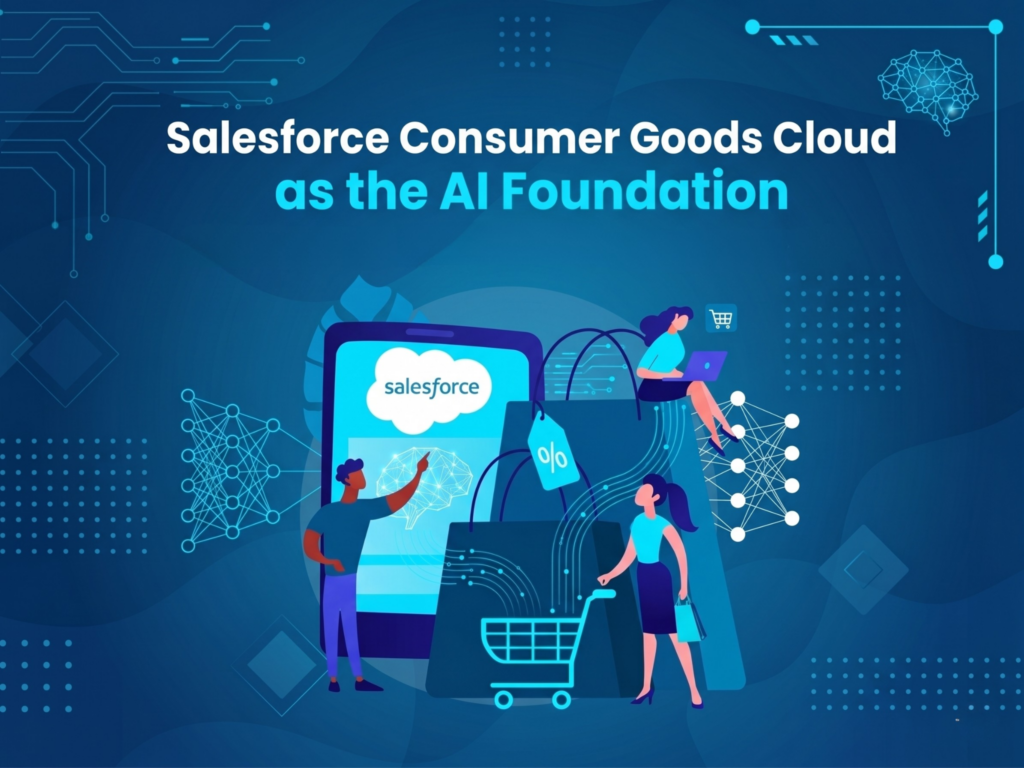
Salesforce Consumer Goods Cloud as the AI Foundation
Salesforce Consumer Goods Cloud is the industry-specific layer built for retail execution, trade promotion management, account planning, and key account management. It sits on the Salesforce platform and shares the same data model as Sales Cloud, Service Cloud, and Marketing Cloud. That shared base removes the data silos that plague CPG companies running disconnected point tools.
Consumer Goods Cloud alone does not deliver AI. The AI power comes when it connects to two more Salesforce products — Data Cloud and Agentforce — each playing a distinct role.
Consumer Goods Cloud handles the operational layer. Data Cloud (now Data 360) serves as the unification layer. It merges retailer POS data, DTC transactions, distributor shipments, syndicated data from Nielsen and Circana, and marketing data into unified consumer profiles. Those profiles feed the Einstein models and Agentforce agents that act on the data.
Data Cloud: The Unification Layer CPG Companies Need
Without Data Cloud, CPG analytics runs on siloed datasets and produces fragmented, unreliable outputs. The partner who bridges Data Cloud setup to CPG data reality decides whether you get a unified intelligence layer or just another disconnected data warehouse.
Data Cloud pulls data from every Salesforce cloud and outside source through pre-built connectors and integration APIs. The unified profile enables cross-channel targeting, AI model training on complete datasets, and real-time segments that update as consumer behaviour changes. Standalone CPG analytics tools cannot match this without heavy custom data work.
For CPG teams looking at the Salesforce ecosystem, Data Cloud is not optional. Loyalty data, purchase patterns, and service interactions that do not flow into Data Cloud stay invisible to the AI models and Agentforce agents running downstream.
Agentforce for CPG: AI Agents in Trade Promotion and Retail Execution
Agentforce is Salesforce’s AI agent platform. In CPG, agents reason, plan, and run workflows on their own. They detect at-risk accounts from declining order patterns, calculate trade promotion offers, trigger campaigns, and write field rep action plans.
The split between trade promotion management (TPM) and trade promotion tuning (TPO) matters here. TPM is the operational system tracking promotion execution, deductions, and settlements — the work Consumer Goods Cloud handles natively. TPO uses AI to model promotion scenarios, predict lift, and recommend where to spend. Agentforce adds the TPO layer, enabling self-running agents in production settings.
MuleSoft Agent Fabric provides the wiring layer. Agents reach ERP inventory data, retailer portals, and logistics systems through MCP (Model Context Protocol) connectors. That means the agents access every system in the CPG stack without custom point-to-point links for each data source.
In retail execution, Agentforce agents set store-visit priorities based on compliance scores, create shelf-reset instructions, and route field reps based on real-time location and urgency. The reasoning layer runs on the unified profiles in Data Cloud — the same profiles feeding demand forecasting and trade promotion models.
If you are building CPG architecture today, make sure your platform exposes agent-ready APIs. The gateway linking large language models to enterprise data through MuleSoft is the pattern that will define the next wave of CPG AI builds.
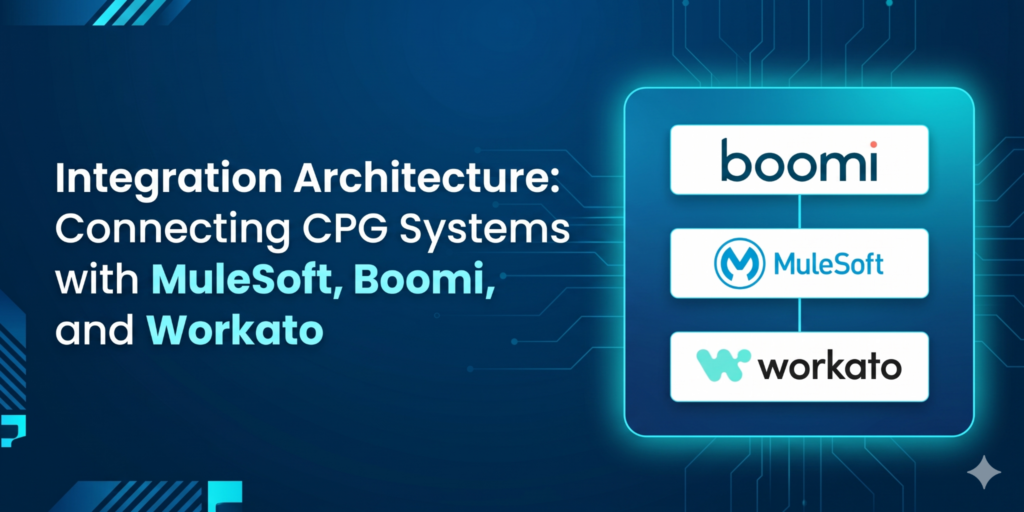
Integration Architecture: Connecting CPG Systems with MuleSoft, Boomi, and Workato
CPG enterprises do not run on a single platform. Most large consumer goods companies run SAP ECC or S/4HANA alongside Salesforce, with Oracle EBS, JD Edwards, or AS/400 legacy systems handling specific functions. The multi-iPaaS practice exists because no single platform handles every CPG integration pattern.
Why CPG Teams Need More Than One Integration Platform
MuleSoft provides API-led wiring within the Salesforce ecosystem. System APIs expose ERP data. Process APIs add business logic like promotion checks and inventory lookups. Experience APIs serve Consumer Goods Cloud and Agentforce. It is the native path for Agentforce through Agent Fabric.
But MuleSoft is not the best choice for every layer. Boomi handles legacy ERP integration with prebuilt SAP and Oracle connectors, cutting months of custom mapping work. Workato handles event-driven SaaS workflows with recipe-based automation — Slack alerts on promotion approval, ServiceNow tickets on compliance failures, JIRA tasks on integration errors.
The multi-iPaaS pattern is the realistic setup for CPG teams running mixed tech stacks. The framework for choosing between platforms assigns each to its strength rather than forcing one vendor to handle patterns it was not built for.
The Multi-iPaaS Pattern for CPG
| Integration Layer | MuleSoft | Boomi | Workato |
|---|---|---|---|
| Salesforce ↔ Salesforce | Native (preferred) | Supported | Supported |
| SAP/Oracle ERP | API-led (custom) | Pre-built connectors (preferred) | Limited |
| Retailer EDI/Portal | API-led (custom) | Pre-built EDI | Connector marketplace |
| SaaS Orchestration | Supported | Supported | Recipe-based (preferred) |
| Agentforce/Agent Fabric | Native MCP connectors | Via API | Via API |
| Real-time Events | Anypoint MQ | Flow (limited) | Event streams (preferred) |
Retailer data adds another layer of complexity. EDI 852, 855, and 856 transactions, retailer portal APIs, and syndicated data feeds from Nielsen, IRI, and Circana each need dedicated connectors or custom integration work.
For Canadian CPG companies, data residency rules under PIPEDA add a constraint. Consumer data must route through Canadian-region instances. The integration layer must enforce this at the API level — not through manual data handling policies.
Natural-language integration flows are already compressing API development cycles. This will cut the timeline and cost for CPG integration projects over the next twelve to eighteen months.
Build Roadmap: From Assessment to Production
Timeline depends on scale, data maturity, and the number of connected systems in your existing stack.
Phase 1: AI Operating Model Assessment (Weeks 1–3)
The structured assessment measures AI readiness before a single dollar is spent on the build. It finds the highest-ROI use cases, maps integration needs across ERP, WMS, TMS, and retailer systems, and produces a prioritized build roadmap.
Phase 2: Data Foundation and Integration (Weeks 4–10)
Deploy Data Cloud, set up data streams from Salesforce clouds and outside sources, and build the integration layer. This is where the multi-iPaaS design takes shape — MuleSoft for Salesforce-native wiring, Boomi or Workato for legacy ERP and SaaS flows.
Phase 3: AI Model Deployment and Agent Setup (Weeks 10–16)
Set up Consumer Goods Cloud for trade promotion and retail execution. Deploy Einstein models for demand forecasting and consumer segmentation. Configure Agentforce agents for self-running workflow execution within guardrails.
Phase 4: Production Rollout and Forward Deployed Engineering (Weeks 16–20)
The Forward Deployed Engineering model embeds engineers within client teams during go-live. They fix edge cases in production, tune agent behaviour with real data, and compress post-launch stabilization from months to weeks.
A mid-market CPG build takes 16 to 20 weeks from assessment through production. Large-scale builds — multi-brand, multi-region, complex ERP setups — extend to 20 to 30 weeks. The accelerator program compresses the path from proof of concept to production for teams that need to move faster.
What to Evaluate Before Choosing a CPG AI Platform
Six criteria should drive your platform choice.
- Data unification. Does the platform merge retailer POS, DTC, distributor, and syndicated data into a single profile? Or does it need custom data engineering to get there?
- Integration depth. The platform must connect to existing ERPs natively or through proven iPaaS connectors — not custom middleware that adds upkeep overhead.
- Agentic AI readiness. The platform should support AI agents with enterprise guardrails, audit trails, and the deployment frameworks production settings demand.
- Multi-cloud design. A platform sharing a data model with the CRM, marketing, and service layers cuts the integration tax that standalone CPG analytics tools impose.
- Partner ecosystem. The vendor must have certified partners with CPG-specific deployment experience. Evaluation criteria should include vertical industry expertise alongside technical certification.
- Data residency compliance. Canadian, EU, and sector-specific rules require the platform to run in your region without workarounds.
Frequently Asked Questions
What Is Generative AI in CPG and How Does It Differ from Traditional Analytics?
Generative AI creates new outputs — promotion scenarios, demand narratives, and agent-driven decisions — while traditional analytics reports on past patterns. In CPG, generative models simulate thousands of trade promotion combos before budget commitment. Traditional analytics only measures what has already happened.
How Does Salesforce Consumer Goods Cloud Support AI for CPG Companies?
Consumer Goods Cloud provides the industry-specific layer for retail execution, trade promotion management, and account planning. Connected to Data Cloud and Agentforce, it becomes an AI-native platform where unified consumer profiles feed predictive models and agents act on AI-generated recommendations.
What Data Sources Does a CPG AI Platform Need to Ingest?
A production-grade build pulls in retailer point-of-sale data, DTC transactions, distributor shipments, syndicated market data from Nielsen and Circana, marketing engagement data, and service records. Data Cloud unifies these into a single consumer profile that AI models and Agentforce agents consume.
Do CPG Companies Need MuleSoft for AI Integration?
MuleSoft provides API-led wiring within the Salesforce ecosystem and is the native path for Agentforce agents through Agent Fabric. But CPG companies running SAP or Oracle ERPs often need a second platform — Boomi for legacy integration or Workato for event-driven SaaS flows.
How Long Does a CPG AI Build with Salesforce Take?
A mid-market deployment takes 16 to 20 weeks from assessment through production. Enterprise-scale builds can take 20 to 30 weeks. The timeline shrinks when a Forward Deployed Engineering model embeds engineers within the client team during go-live.
Can CPG Companies Use Generative AI Without Replacing Their ERP?
No ERP replacement needed. The integration layer wraps existing SAP, Oracle, and JD Edwards systems with API layers that expose data to Salesforce and AI models. MuleSoft’s system APIs connect to ERP endpoints, process APIs add business logic, and experience APIs serve Consumer Goods Cloud and Agentforce.
What Is Agentforce and Why Does It Matter for CPG?
Agentforce is Salesforce’s AI agent platform. In CPG, agents monitor account health, detect declining order patterns, calculate trade promotion offers, and trigger field rep action plans. MuleSoft Agent Fabric provides the wiring layer through MCP connectors to reach ERP inventory, retailer portals, and logistics systems.
What Is the Difference Between a Single-iPaaS and Multi-iPaaS Strategy for CPG?
A single iPaaS strategy uses one platform for all connections, creating bottlenecks. MuleSoft handles Salesforce-native wiring. Boomi handles legacy ERP connectors. Workato handles event-driven SaaS flows. A multi-iPaaS strategy assigns each platform to its strength, stopping the point-to-point sprawl that single-vendor setups produce.
Where Incepta Fits
Incepta’s multi-iPaaS expertise — spanning MuleSoft, Boomi, Workato, and SnapLogic — maps directly to the integration complexity CPG projects demand.
The AI Catalyst program gives a structured path from assessment to production. Forward Deployed Engineering cuts the months-long post-launch stabilization phase that derails CPG AI projects.
The CPG and retail practice brings Consumer Goods Cloud, Data Cloud, and Agentforce to build experience. The team connects these platforms to ERPs, retailer systems, and syndicated data feeds. The no-cost AI Operating Model Assessment finds the highest-ROI use cases before any build commitment.