

Salesforce has roughly 29,000 Agentforce new customers and processes billions of automated workflows each month.
With that much production volume, the Agentforce implementation partner you pick needs to build AI agents that actually perform across sales, service, and operations.
Salesforce’s Agentforce Partner Network spans thousands of firms. But Salesforce trimmed its Partner Program from four tiers to two (Select and Summit) in early 2026, and Agentforce skills vary widely between those firms.
Many others are repurposing their standard Salesforce teams for what is a very different kind of project. Below, we unpack what to look for, what to ask, and what to avoid when choosing an Agentforce consulting partner.
What Agentforce Actually Requires from a Salesforce Agentforce Partner
Agentforce’s Atlas Reasoning Engine is a System 2 architecture. It plans in multiple steps, gathers context, runs actions, and checks its own results before answering. Building agents on it looks less like setting up a Salesforce Flow and more like designing a machine learning pipeline — so evaluate partners accordingly.
A qualified partner needs to demonstrate:
- Full agent architecture knowledge. Topics, Instructions, Actions, Guardrails, and Channels. If the partner cannot walk you through how these pieces fit together, they are not ready for production Agentforce work.
- Data grounding through Data Cloud (now rebranded as Data 360). This means unified profiles, identity matching, and knowledge base vectorization. Agents built on bad profiles give bad answers.
- Einstein Trust Layer expertise. PII masking, toxicity filtering, and zero-data-retention policies. Any partner working in healthcare, financial services, or the public sector must show depth here.
- Agent Builder proficiency. The 2026 Builder uses a graph-based engine, Agent Script, Canvas view, and Agent Previews for testing. Ask the partner to demo a build — not a slide deck.
- Cross-cloud orchestration. Agentforce agents increasingly span Sales Cloud, Service Cloud, Commerce Cloud, and Marketing Cloud in a single workflow. A partner who has only built single-cloud automations will struggle here.
- MuleSoft Agent Fabric integration. If you run SAP, NetSuite, or legacy ERPs, the MCP Connector and A2A Connector are the only path for agents to reach data beyond Salesforce.

Why Most Traditional Salesforce Partners Are Not Ready for Agentforce
Traditional Salesforce implementation skills — Flows, Apex, declarative setup — still matter, but they are table stakes. What separates Agentforce-ready partners from the rest:
- LLM prompt engineering and reasoning trace debugging. When an agent gives a wrong answer, the partner needs to trace the Atlas Reasoning Engine’s decision chain to find out why. This is a different skill from debugging a Flow or Apex trigger.
- Data Cloud architecture. Unified profiles, identity matching, and vector embeddings. Without this, Agentforce development stalls at the data layer.
- AI governance. Guardrail design and compliance configuration for HIPAA, SOC 2, or GDPR through the Einstein Trust Layer. Most standard Salesforce consulting partners have not built this muscle.
- Multi-system orchestration through MuleSoft. Without it, agents can only touch Salesforce data — which leaves them incomplete for most enterprise workflows.
Ask the partner how many production Agentforce agents they have deployed — not how many they have demoed.
Understanding the New Salesforce Partner Program in 2026
Salesforce collapsed the old four-tier partner system (Base, Ridge, Crest, Summit) into two tiers in early 2026. The change affects how you read a partner’s status.
- Select Partners have proven delivery ability and meet clear performance standards across Salesforce work.
- Summit Partners sit at the top. These firms bring the deepest expertise in complex, multi-cloud, AI-driven projects.
For an Agentforce deployment, a Summit-level partner with proven AI and Data Cloud skills is the safer pick, especially for projects involving cross-cloud workflows or non-Salesforce data.
Salesforce also replaced the Navigator badge system with 28 core competencies, measured through certifications, finished projects, and customer satisfaction scores. Each competency has two levels: Accredited (proven ability) and Expert (scaled delivery across multiple projects).
Which Certifications and Competencies Matter for Agentforce?
When evaluating partners, focus on four areas:
- Salesforce AI Specialist Certification. This covers Agentforce, Einstein Trust Layer, Prompt Builder, and generative AI in CRM. It is the most direct proof that a partner’s team understands the AI layer, not just CRM configuration.
- Data Cloud competency (Accredited or Expert). The partner can set up unified profiles, manage identity matching, and handle the data backbone that agents depend on.
- AI competency (Expert level). This signals that the partner has shipped AI projects at scale, not just run a proof of concept. It carries more weight for enterprise work.
- MuleSoft competency. Essential if you need to connect non-Salesforce systems. Without it, agents cannot reach SAP, legacy ERPs, or outside databases — which sharply limits what Agentforce can do in complex enterprise settings.
Ask directly: “How many certified AI Specialists are on your team?” A partner without current AI certifications is learning on your project.
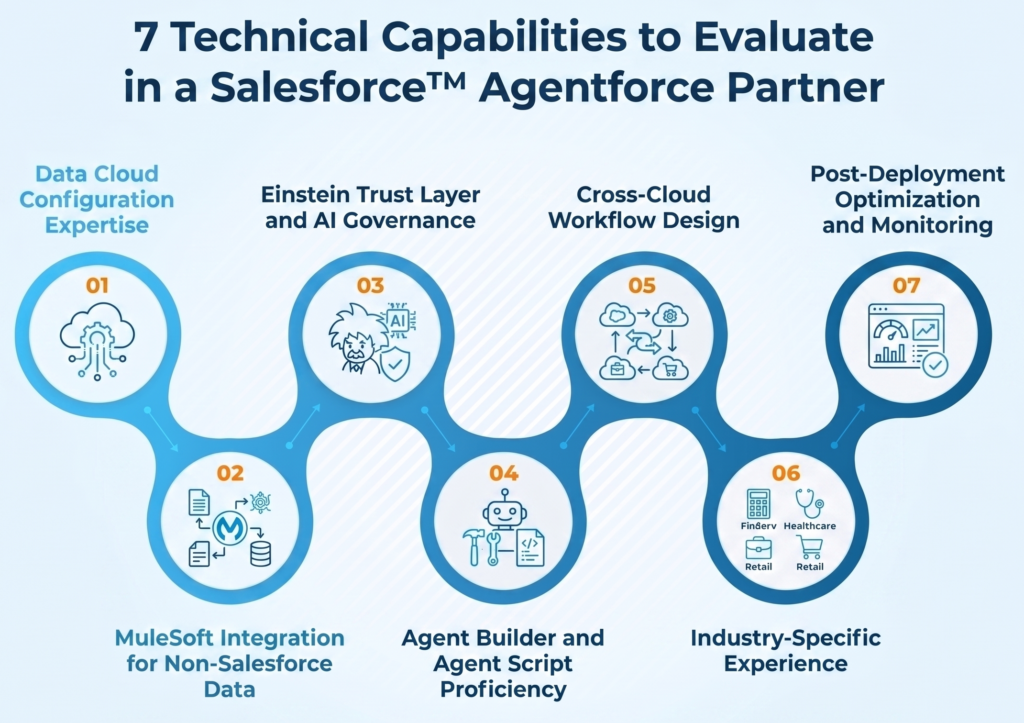
7 Technical Capabilities to Evaluate in a Salesforce Agentforce Partner
Each capability below includes an evaluation question you can use during the selection process to separate partners who have done the work from those selling the idea of it.
1. Data Cloud Configuration Expertise
Agents pull answers from whatever data they can reach. The partner needs to show they can set up Data Cloud to unify customer profiles across CRM, marketing, commerce, and outside systems — duplicate removal, identity matching, and data quality controls included.
Evaluation question: “Walk me through how you would set up Data Cloud for our customer base, including deduplication and profile unification across our systems.”
2. MuleSoft Integration for Non-Salesforce Data
Without MuleSoft Agent Fabric, Agentforce agents can only see data inside Salesforce. If you run SAP, NetSuite, legacy ERPs, or other SaaS platforms, that caps agent value fast.
Look for skill with MuleSoft’s MCP Connector (which exposes APIs as agent-ready tools), the A2A Connector for multi-platform orchestration, and Flex Gateway policies for securing agent-to-system connections.
Evaluation question: “Show me how you would let an Agentforce agent pull real-time data from our SAP system.”
This capability splits the partner market most sharply. A partner like Incepta covers both Salesforce and MuleSoft in one engagement. With over 60 integration experts and 1,500 APIs deployed, you avoid the overhead of hiring separate firms for each layer.
3. Einstein Trust Layer and AI Governance
The partner needs to show they can set up the Einstein Trust Layer. That means PII masking before data reaches the LLM, toxicity filtering, audit trails, and zero data retention enforcement. In regulated industries, skip any partner who cannot speak to this in detail.
Evaluation question: “What is your approach to setting up the Einstein Trust Layer for our compliance needs, whether HIPAA, SOC 2, or GDPR?”
4. Agent Builder and Agent Script Proficiency
The 2026 Agentforce Builder blends fixed workflow paths with flexible LLM reasoning through a graph-based engine. Look for partners who can work in Canvas view, author Agent Script for key business logic, and test through Agent Previews with reasoning trace analysis.
Evaluation question: “Can you demonstrate building an agent using Agent Script for one of our use cases?”
5. Cross-Cloud Workflow Design
Agentforce agents can coordinate actions across Sales Cloud, Service Cloud, Commerce Cloud, Marketing Cloud, and Data Cloud in one workflow. Probe for experience designing multi-cloud agent workflows, not single-cloud setups that any team could build with standard tools.
Evaluation question: “Describe a production agent you have built that spans multiple Salesforce clouds.”
6. Industry-Specific Experience
An agent handling financial services compliance faces different data sources, rules, and escalation patterns than one managing retail order fulfilment or healthcare patient engagement. Partners with experience in your industry will reach production faster and avoid compliance mistakes that generalists make.
Evaluation question: “What agents have you built in our industry, and what data sources and compliance concerns did you handle?”
7. Post-Deployment Optimization and Monitoring
Agentforce agents need ongoing tuning — conversation outcome tracking, escalation rate analysis, and iterative improvements through Agentforce Analytics. Any partner who frames this as a one-time build-and-handoff project has not shipped agents at scale.
Evaluation question: “What does your post-deployment support look like? How do you track and improve agent performance over time?”
Agentforce Pricing: What to Budget For
Knowing the full cost structure lets you spot whether a partner is giving you real numbers or lowballing to win the deal. Account for all of these when modeling total costs:
- Flex Credits Model (current default). 20 credits per agent action, or roughly $0.10 per action. Best for high-volume, low-complexity interactions — routine questions that AI agents handle on their own.
- Conversations Model (legacy). $2.00 per conversation covering any interaction within a 24-hour window. This can be cheaper for complex, multi-action sessions where one conversation triggers dozens of agent actions.
- Free tier. Salesforce Foundations includes 200,000 Flex Credits and 250,000 Data 360 credits — enough for meaningful testing before you commit to production licensing.
Beyond Agentforce usage, budget for Data Cloud licensing (credits or profiles), MuleSoft licensing if integrating non-Salesforce systems, and the Agentforce User Licence at roughly $5 per user per month.
The total cost of ownership covers consulting partner fees, Data Cloud, MuleSoft where needed, and ongoing optimization — not just usage credits. A partner who only quotes Agentforce consumption is leaving out the biggest cost drivers. Ask for the full model during the scoping phase.
Typical Agentforce Implementation Timeline
Timelines depend on data readiness, integration complexity, and how many use cases you are targeting. A realistic breakdown:
Strategy and scoping: two to four weeks. Use case ranking, data readiness checks, and partner alignment.
Pilot build: four to eight weeks. Data Cloud setup, Trust Layer configuration, Agent Builder work, and sandbox testing.
Pilot review: two to three weeks. Performance analysis, instruction tuning, and guardrail adjustments.
Phased production rollout: eight to sixteen weeks or more. Gradually adding use cases, channels, and user groups.
Total time from pilot to scaled production typically runs four to six months for a mid-level deployment. Data readiness and MuleSoft integration complexity push timelines longer.
A partner offering a four-week QuickStart for the first agent can deliver fast ROI on a pilot while you build toward the broader rollout.
Red Flags When Evaluating a Salesforce Agentforce Partner
Watch for these warning signs when reviewing a Salesforce Agentforce partner:
No AI-specific certifications. The Salesforce AI Specialist credential validates Agentforce skills directly. If no one on the partner’s team holds it, they are learning on your project.
Demo-only experience. Demos and proofs of concept look nothing like production agents handling real customer interactions at scale. The hard parts — guardrail tuning, edge case handling, reasoning trace debugging — only surface in live environments. Ask for production references.
Feature talk instead of outcome talk. A strong partner leads with business metrics: resolution rate, deflection rate, and customer satisfaction scores. A partner who walks you through feature lists instead is selling the platform, not solving your problem.
No MuleSoft integration plan. If you run SAP, legacy ERPs, or outside databases, and the partner cannot explain how agents will reach that data, those agents will only access a fraction of what they need.
Vague pricing. A strong partner should model total costs across Agentforce usage, Data Cloud, MuleSoft, and consulting fees during the evaluation phase — not after you sign the contract.
“Set it and forget it” framing. Agentforce agents need ongoing monitoring and refinement. The Atlas Reasoning Engine’s behavior shifts as your data changes. Instructions, guardrails, and action configurations need regular updates. Any partner who suggests otherwise has not managed agents in production.
How Incepta Approaches Agentforce Engagements
Incepta Solutions brings Salesforce consulting, MuleSoft integration, and Data and Generative AI together in one team — avoiding the coordination problems and accountability gaps that come from hiring separate partners for each layer.
Incepta holds certified Salesforce Summit Consulting Partner and MuleSoft Premier Partner status, with over 900 Salesforce implementations and 1,500 APIs deployed across industries. Because Incepta covers both platforms, agents can access SAP, ERPs, and non-Salesforce systems from day one through Agent Fabric and MCP Connectors — a capability most Agentforce-only partners cannot offer.
Before building anything, Incepta runs an AI Operating Model Assessment to identify the highest-impact Agentforce use cases and flag data readiness gaps. The firm works across CPG and retail, banking and financial services, healthcare, manufacturing, and the public sector, so the agents they build reflect real industry constraints, not generic demos.
For enterprises looking for a Salesforce Agentforce partner or integration partner that can unify CRM and non-CRM data from day one, Incepta’s record across both platforms is worth evaluating. To start, request an Agentforce Readiness Assessment.
Frequently Asked Questions
How Do I Find a Certified Salesforce Agentforce Partner?
Start with Salesforce’s AppExchange Partner Directory, filtered by AI competency. Check that the partner holds Salesforce AI Specialist certifications and has Expert-level status in AI and Data Cloud under the 2026 partner program. Ask for references from production deployments, not pilots or demos — the complexity gap between the two is wide. A Summit-tier partner with both Salesforce and MuleSoft credentials is typically the stronger choice for enterprise-scale work.
Do I Need MuleSoft for Agentforce?
If your agents only need Salesforce data, no. But if they need to connect with SAP, legacy ERPs, outside databases, or non-Salesforce APIs, MuleSoft Agent Fabric provides the link through MCP and A2A connectors. For most enterprises with mixed technology stacks, the answer is yes. Without MuleSoft, agents can only reach a portion of the data they need for accurate answers.
How Much Does an Agentforce Implementation Cost?
Total costs cover Agentforce usage (roughly $0.10 per action on Flex Credits or $2.00 per conversation on the older model), Data Cloud licensing, optional MuleSoft licensing, and consulting fees. A focused pilot of one to two use cases typically costs $50,000 to $150,000 in consulting. Enterprise-scale projects across multiple clouds and integrations can top $200,000 in services. A good partner should provide a detailed cost model during scoping.
How Long Does Agentforce Implementation Take?
A focused pilot of one to two use cases takes four to eight weeks to build and test. Full production deployment usually needs four to six months from pilot to scaled rollout. Data readiness, integration complexity, and the number of Salesforce clouds involved mainly drive the timeline. Incepta’s AgentForce QuickStart delivers a first production agent in four weeks, giving fast ROI while longer-term phases continue.
What Is the Biggest Risk in an Agentforce Project?
Poor data quality. The Atlas Reasoning Engine amplifies data problems — agents will give confident but wrong answers from incomplete or duplicate records. Data Cloud setup and data cleansing form the base of every successful deployment. Enterprises that skimp on data readiness before launching agents typically see higher escalation rates, lower customer satisfaction, and costly fixes after go-live. A structured readiness assessment before starting is the best way to cut that risk.