
The 30-Second Answer
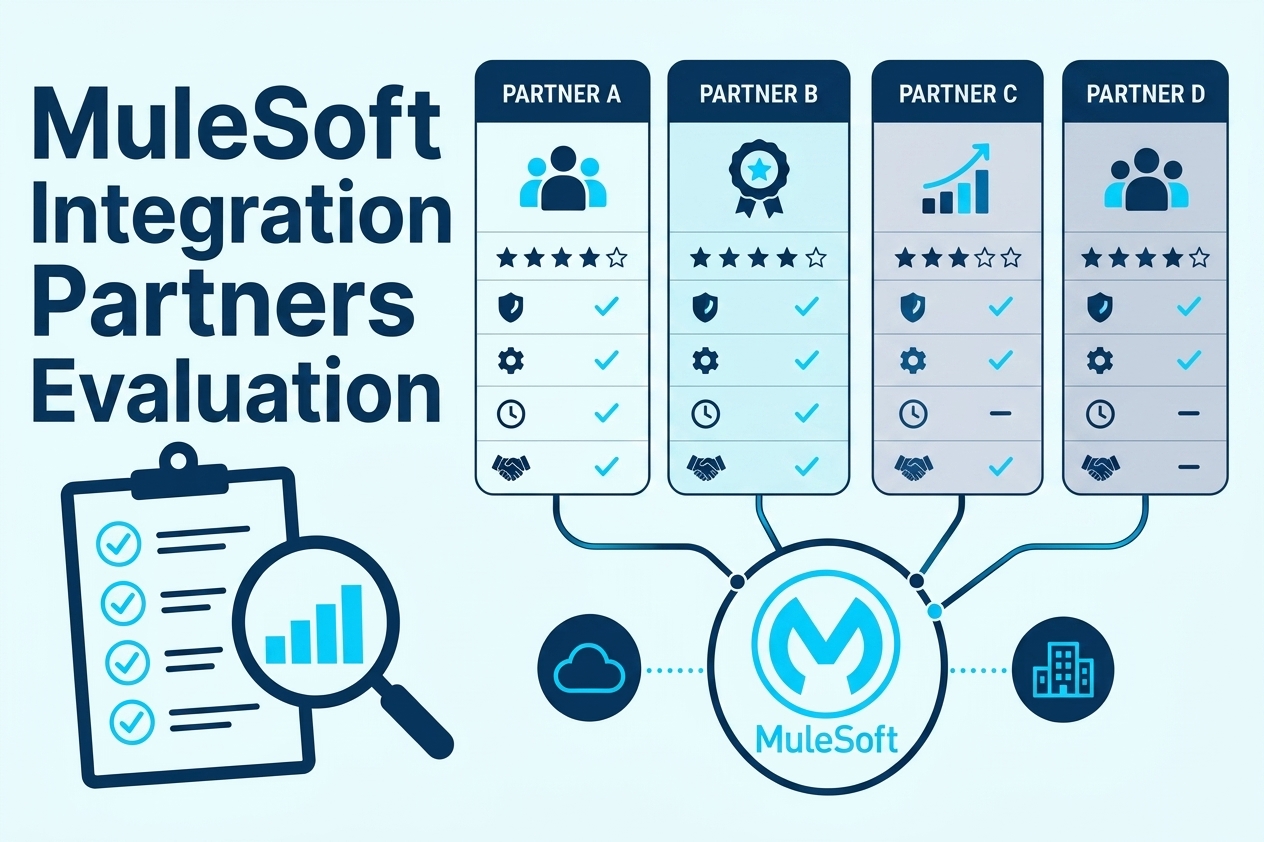
There is no single best MuleSoft integration partner. The MuleSoft integration services market splits into four bands, and the right one depends on your estate size, your governance obligations, and who owns integration after go-live.
- Global system integrators for multi-year, multi-geography programs
- Salesforce-ecosystem specialists for Salesforce-anchored estates
- Mid-market integration specialists for defined estates at 500 to 5,000 employees
- Offshore and nearshore delivery shops for cost-constrained builds you architect yourself
What MuleSoft integration services actually cover
MuleSoft integration services are the consulting and engineering work required to design, build, and operate an integration architecture on the MuleSoft Anypoint Platform. MuleSoft consulting services range from a two-week assessment to multi-year managed delivery.
One distinction matters before you shortlist anyone. Partner firms sell “MuleSoft professional services” as a description of their own work, and MuleSoft sells first-party Professional Services and Catalyst engagements under a similar name.
Those are two different vendors with different economics. Searching the phrase returns both, and buyers routinely assume they are looking at one option when they are looking at two.
The three API layers, and why the layer split shows up in your contract
API-led connectivity structures integrations into three layers. System APIs expose source data, Process APIs orchestrate business logic, and Experience APIs shape data for a specific consumer.
The practical consequence is contractual. A partner who only builds Experience APIs leaves you with the same point-to-point problem you started with, wrapped in newer technology.
Ask any MuleSoft integration partner to show work at all three layers. A firm that cannot produce System API examples has been doing surface work rather than API-led connectivity, and the difference shows up in what you inherit when the engagement ends.
The Anypoint Platform spans three product categories that buyers often flatten into one. It functions as an integration platform as a service (iPaaS), as an API management layer, and as a replacement for legacy enterprise service bus (ESB) middleware.
If you only need one of those three, MuleSoft is likely over-specified for your job. That question deserves resolution before you evaluate MuleSoft integration services, and the platform-fit comparison belongs earlier in your process than most buyers place it.
What sits inside a typical MuleSoft consulting scope
- Platform assessment and target-state architecture
- API-led connectivity strategy, design, and build across all three layers
- Legacy system modernization and enterprise integration bus replacement
- Mule 3 to Mule 4 migration
- CloudHub 2.0 and Runtime Fabric deployment
- API governance, versioning, and lifecycle management on the Anypoint Platform
- Managed support with defined service levels
Why most “best MuleSoft partner” lists will not help you
Across the eight highest-ranking “best MuleSoft integration services” pages reviewed in August 2026, every list that includes its own publisher places that publisher at number one. Not most of them. All of them.
That pattern is easy to verify yourself. Open any of the top-ranking MuleSoft integration services pages, scroll to the first entry, and check the byline against the firm named.
The lists do not agree on who belongs
One cluster of pages names Twistellar, Sage IT, ProwessSoft, Ranosys, Pronix, Ksolves, Softwarium, and Closeloop. A separate cluster names Watsoo, United Techno, Melonleaf, Cube84, Teqfocus, Accelirate, Girikon, and K2 Partnering Solutions.
There is almost no overlap between them. A market with a genuine consensus shortlist does not produce two disjoint top-ten lists in the same quarter.
The content is also recycled. Statistics, vendor descriptions, and entire definition paragraphs move between these pages verbatim, occasionally carrying the original publisher’s internal links along with them.
At least one domain in this category exists solely to rank a single firm at number one, complete with an “editorial review” section that names no reviewer. The apparatus of independence is easier to fake than independence.
The largest MuleSoft delivery organizations are missing
Almost none of these lists include the firms doing the highest volume of MuleSoft integration work globally. Those organizations do not need to write listicles, so they do not appear in listicles.
That absence tells you what the lists actually measure. They measure content marketing effort, not delivery capability, and the same dynamic distorts vendor lists across the Salesforce ecosystem.
Where we sit in our own list
Incepta is included in the shortlist further down this page, in the mid-market integration specialist band. We did not put ourselves first, and we have stated our limitations alongside everyone else’s.
We take the same position on partner selection that we take when comparing the platforms themselves, which is that the honest answer usually excludes us for some jobs.
Nine criteria that actually separate MuleSoft partners
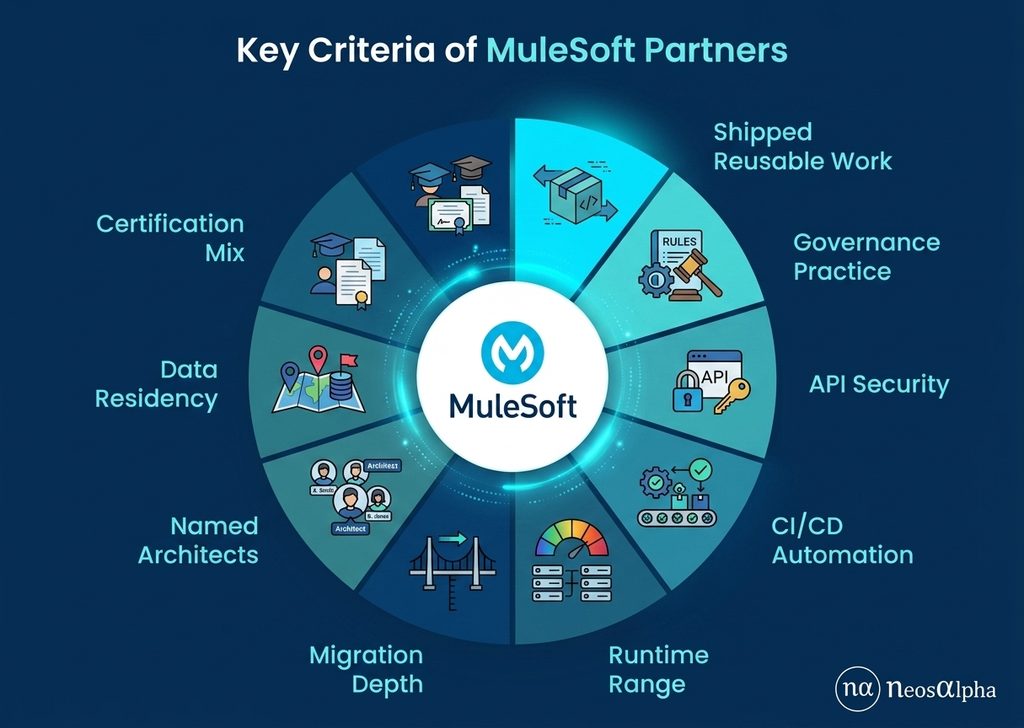
Generic consultant-evaluation advice will not distinguish one MuleSoft integration partner from another. Every candidate will claim certifications, governance, and security. The criteria below are the ones with MuleSoft-specific answers that a weak firm cannot fake.
| Criterion | What weak partners say | What to ask instead | What good evidence looks like |
|---|---|---|---|
| Certification mix | “We have 40+ certified professionals” | “What is the split between developers, architects, and platform specialists?” | A named breakdown you can check against public listings |
| Shipped reusable work | “We follow API-led best practices” | “What have you published to Anypoint Exchange?” | Named, externally viewable assets |
| Governance practice | “We enforce governance” | “Show me your API versioning and retirement policy” | A written policy, not a slide |
| API security | “Security is built in” | “Which OWASP API Top 10 categories do you test for?” | Named categories and a sample findings report |
| CI/CD automation | “We automate deployments” | “What runs in your pipeline before promotion?” | Contract testing, linting, rollback triggers |
| Runtime range | “We support cloud and on-prem” | “Have you deployed CloudHub 2.0 and Runtime Fabric in production?” | Named engagements per runtime |
| Migration depth | “We handle migrations” | “How many Mule 3 to Mule 4 migrations have you completed?” | Engagement count and DataWeave staffing plan |
| Named architects | “We have a deep bench” | “Name the architect on this engagement and show their certification” | A person, not a headcount |
| Data residency | “We deliver globally” | “Where does integration test data physically reside during the build?” | A contractual commitment |
Certification mix, not certification headcount
A headcount claim tells you almost nothing. Developer, architect, and platform credentials are separate exams that certify different capability, and a firm can hold forty developer certifications with no architect on staff.
Ask for the split. The mix determines whether a firm can architect your estate or only build to a design someone else produced.
Published Anypoint Exchange assets
Anypoint Exchange distinguishes three things buyers conflate. A connector links to a system, a template is a reusable starting pattern, and a published asset is verifiable evidence that a firm shipped reusable work under its own name.
Only the third is externally checkable without a reference call, which makes it the strongest evidence you can gather in an afternoon.
Governance, versioning, and API security
Ask for the written versioning and retirement policy. Firms with real API governance practice produce it immediately, and firms without one produce a slide about the importance of governance.
On API security, name the standard rather than asking whether they do security. The OWASP API Security Top 10 covers broken object level authorization, broken authentication and token misuse, excessive data exposure, and improper asset management, meaning the zombie and shadow APIs that accumulate in every mature estate.
A partner with real API governance practice can describe what an audit of this kind found. The findings pattern is consistent across estates, which is how you tell someone who has done it from someone who has read about it.
Runtime range and migration depth
CloudHub 2.0, Runtime Fabric, and on-premises deployment are different operational disciplines within the Anypoint Platform. Ask for a named engagement per runtime rather than a general claim of hybrid capability.
Migration depth matters because DataWeave specialists are scarce. That scarcity is the real constraint on which firms can actually staff a Mule 4 migration, and it shows up in the rate card long before it shows up in the pitch.
Named architects, not pooled headcount
A bench claim is not a staffing commitment. The question that separates the two is direct: name the architect who will be on this engagement, and show me their certification.
Firms that resell bench capacity struggle with that question. The same test works when hiring individuals rather than firms, and it fails the same vendors both times.
Data residency and cross-border handling
This is the criterion no competing list raises. Every firm ranking for this keyword runs nearshore or offshore delivery, and not one of them tells you to ask where your integration test data lands during a build.
The question set is short. Where does the delivery team sit, where does data physically reside during development and testing, and what of that is contractually committed rather than described in a proposal.
For Canadian institutions, this intersects with third-party risk expectations under OSFI guidance and with Quebec’s Law 25 requirements on transfers outside the province. For US enterprises with cross-border operations, the same question applies in reverse.
A partner who has never been asked this will improvise an answer. One who works in regulated environments will have a documented position, and the assessment stage is where that surfaces rather than during procurement review.
How to verify what a MuleSoft partner claims
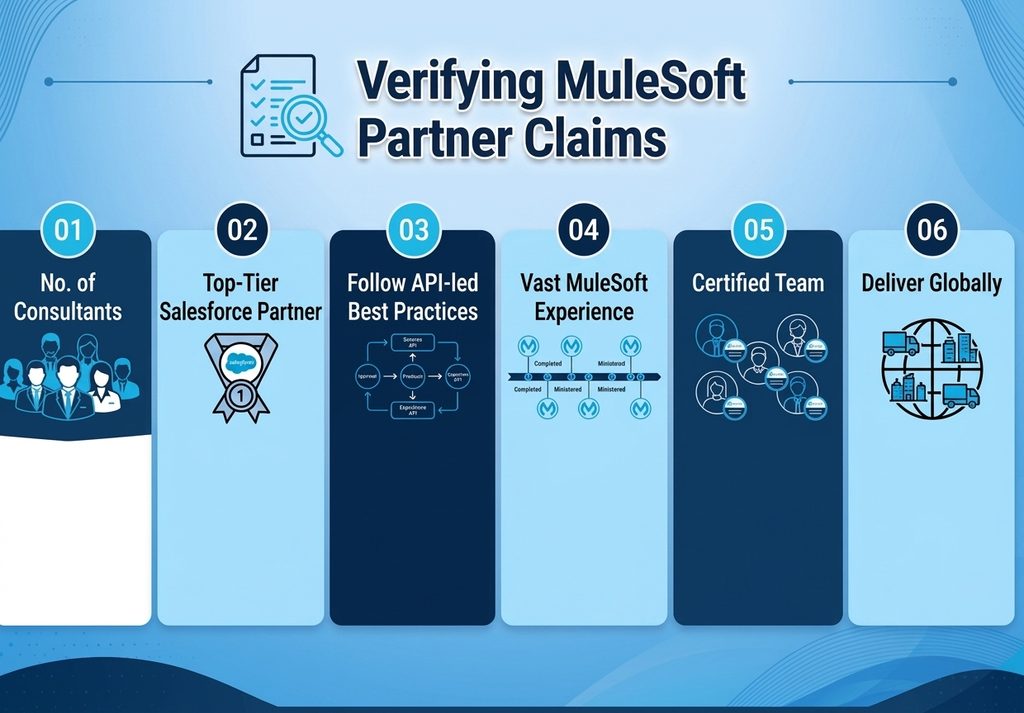
Every MuleSoft integration partner criterion above depends on verification. This section is the procedure, and you can run most of it in an afternoon without contacting a single vendor.
| The claim you will hear | Where to check it | What a failed check looks like |
|---|---|---|
| “We have X certified consultants” | AppExchange consulting listing, compared against the firm’s own site | The two numbers disagree |
| “We are a top-tier Salesforce partner” | Salesforce Partner Finder | Tier is real but ecosystem-wide, not MuleSoft-specific |
| “We follow API-led best practices” | Anypoint Exchange, searched by publisher | No published assets |
| “We have deep MuleSoft experience” | Case studies with named runtimes and system counts | Only logos, no architecture detail |
| “Our team is certified” | Named architect plus credential | Only aggregate headcount offered |
| “We deliver globally” | The signed statement of work | Residency described in the pitch but absent from the contract |
Checking Partner Finder and AppExchange listings
Start at Salesforce Partner Finder and locate the firm. Then open its AppExchange consulting listing and read the certification counts stated there.
Now open the same firm’s website and find the equivalent claim. Compare the two numbers.
This takes about four minutes per firm and eliminates candidates faster than any reference call. A firm that cannot keep its own certification count consistent across two properties it controls is not going to be more careful with your API inventory.
What the partner tiers actually mean, and what they do not
Salesforce operates consulting partner tiers across its ecosystem, and every MuleSoft integration partner displays one. Those tiers are earned on aggregate performance across the whole Salesforce portfolio, not on MuleSoft delivery specifically.
MuleSoft-specific standing is a separate designation. The partner tier and the MuleSoft designation are frequently displayed side by side on partner websites, which invites exactly the conclusion the display is designed to invite.
A firm can hold a high partner tier while having shipped very little MuleSoft integration work. Verify the MuleSoft-specific status separately, and treat a general Salesforce tier as evidence about the Salesforce practice rather than the integration practice.
That distinction is worth raising explicitly with every candidate. The equivalent question on the Salesforce side has a different answer, which is the point.
Reading a certification claim
Once you have a number, ask for its composition. The follow-up questions are specific: how many hold architect-level credentials, how many are currently on active engagements, and how many were certified within the last two years.
Certifications lapse and platforms change. A count that includes Mule 3 era credentials tells you about a firm’s history rather than its current capacity.
Red flags worth acting on
The strongest signal is internal inconsistency. If a firm’s certified-consultant count differs between its website, its AppExchange listing, and its case studies, treat every other number it gives you as unverified until it is proven.
This is not a minor documentation issue. Numbers a firm publishes about itself are the numbers it has the most control over and the most incentive to get right.
Two other flags recur. Case studies that name industries but never name a runtime topology or a system count are usually written by marketing without engineering review, and the ones written with engineering review read differently.
The second is a firm that agrees with your framing throughout the sales process. A partner who never pushes back on your integration architecture assumptions is selling hours rather than judgment.
Reference-call questions that cannot be answered from a template
- Which architect led the engagement, and are they still at the firm
- What was the runtime topology, and why that one
- What broke in production, and what did the fix cost
- What did you have to take back in-house afterward
The fourth question is the most revealing. Every engagement leaves something behind for the client to own, and a partner who claims otherwise has not finished one.
What MuleSoft engagements actually cost
Most MuleSoft consulting content answers this question with “it varies.” Here are the ranges, with sources named.
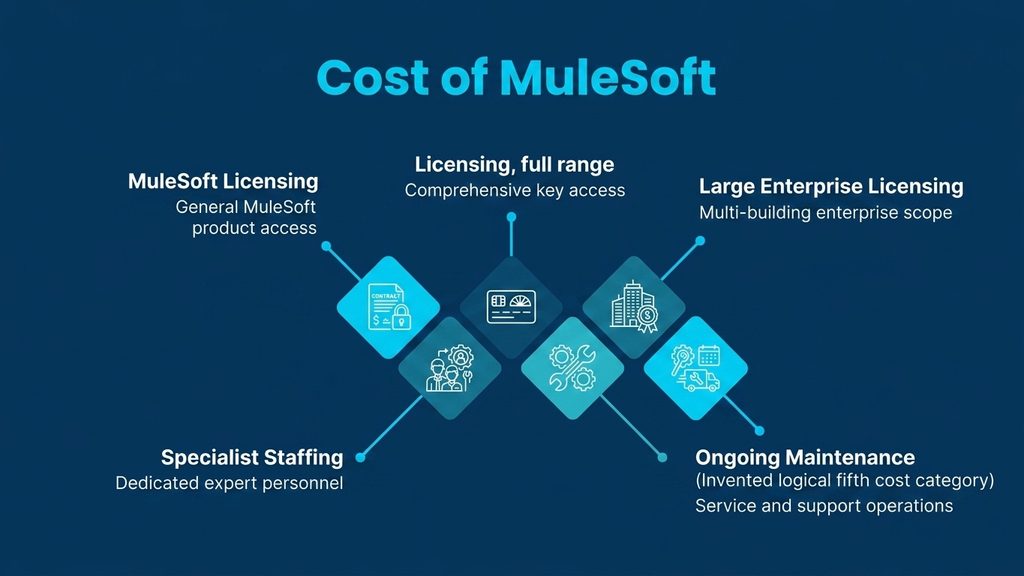
| Component | Typical range | What moves it | Source |
|---|---|---|---|
| MuleSoft licensing | Median roughly $55,000 to $69,000 per year | API volume, environments, support tier | Vendr procurement data, reviewed by Costbench and CheckThat |
| Licensing, full range | Roughly $10,000 to $259,000 per year | Deployment scale | Vendr procurement data |
| Large enterprise licensing | $250,000 to $600,000 or more | Multi-org, high transaction volume | Vendr procurement data |
| Specialist staffing | $150,000 to $200,000 per DataWeave developer | Talent scarcity in the local market | Industry salary data |
Licence, delivery, and managed support are three separate bills
Buyers routinely scope the licence and forget the other two. Enterprise integration delivery is a project cost, managed support is a recurring cost, and the licence is the smallest of the three on most enterprise programs.
Partner-published estimates place total annual MuleSoft program cost, including licensing, builds, and support, somewhere above $70,000 and frequently past $250,000. Treat any single figure as a starting point for scoping rather than a quote.
The staffing cost buyers underestimate
DataWeave expertise is the constraint that surprises people. Industry salary data places specialists in the $150,000 to $200,000 band, and first-year totals for a small in-house team often run higher than the licence itself.
That number is also why the make-or-buy question deserves real analysis. We work through it in the platform comparisons because the answer frequently changes the platform decision as well as the sourcing decision.
Realistic timelines
Focused, well-scoped work commonly lands in a two-week to four-month window. Multi-system programs with legacy dependencies run considerably longer, and the variable is almost always the state of the source systems rather than the integration work.
One caution on vendor-published returns. MuleSoft’s own comparison marketing claims 78% faster time to market, 57% higher productivity, and 30% cost reduction, drawn from Salesforce-commissioned benchmarks.
Those are vendor claims. Use them to understand the argument being made, not to build your business case, and apply the same discount to every platform’s published figures.
For a sense of what well-executed reuse produces, MuleSoft has published customer results including a university team that built 60 APIs in six months at 87% reuse, and separately reported roughly $12,000 in savings per reused API at one organization. A statewide hybrid rollout in the State of Colorado completed in six months.
Firms worth shortlisting in 2026
This section is grouped by fit rather than ranked one through ten. Ranking would reproduce exactly the behavior criticized earlier in this article.
| Band | Best for | Typical engagement | Main trade-off |
|---|---|---|---|
| Global system integrators | Multi-year, multi-geography transformation | Seven figures and up | Process overhead, high minimums |
| Salesforce-ecosystem specialists | Salesforce-anchored estates | Six figures | Depth outside Salesforce varies |
| Mid-market integration specialists | Defined estates, 500 to 5,000 employees | Mid to high six figures | Bench depth below the global SIs |
| Offshore and nearshore delivery | Cost-constrained builds | Lower five to six figures | You own the architecture |
Global system integrators
NTT DATA is the clearest case in this band. Following its acquisition of Apisero, it publicly identifies as MuleSoft’s second-largest global partner and an eight-time MuleSoft Partner of the Year award winner, with a combined consultant base in the thousands.
Accenture, Deloitte Digital, Capgemini, Coforge, and Slalom also operate substantial MuleSoft practices and appear consistently in analyst-oriented rankings of implementation partners.
Where they fit: programs spanning multiple geographies, multi-year roadmaps, and organizations that need a partner able to absorb scope changes without renegotiating.
Limitations: minimum engagement sizes exclude most mid-market work, and decision cycles are slower. Ask specifically which practice within the firm will staff your work, because MuleSoft depth varies significantly by region inside large SIs.
Salesforce-ecosystem specialists
Firms in this band anchor on Salesforce and treat MuleSoft integration as the connectivity layer around it. That is the right shape when your integration problem is fundamentally about getting data into and out of Salesforce.
Where they fit: Salesforce-centric estates where the integration scope is defined by CRM boundaries.
Limitations: verify depth on the non-Salesforce side. Ask for named engagements involving SAP, mainframe, or on-premises ERP systems before assuming that capability exists.
Mid-market integration specialists
This band handles defined estates at organizations too large for a single-consultant engagement and too small to interest a global SI. Incepta sits here.
What we do well: Incepta has been a MuleSoft Premier Partner since 2017 as a value-added reseller and system integrator. Enterprise integration delivery covers financial services, telecom, retail, and public sector, with certified MuleSoft consulting practices alongside Boomi and Workato. A Forward Deployed Engineering model covers the period after go-live.
Structured MuleSoft consulting entry points exist at both ends of the risk spectrum. A platform assessment produces a target-state architecture and roadmap before any build commitment, and a security assessment audits an existing estate against the OWASP categories named earlier.
Representative work: a North American pet retail enterprise migration consolidated more than 70 APIs and applications across AWS and Azure with no service disruption. A Canadian government client adopted MuleSoft to connect an ecommerce platform to ERP, warehouse management, and payment gateway systems for a new line of business. A Canadian fintech engagement covered API security posture on external-facing endpoints.
Limitations: we are not the right choice for a single narrow connector build, where the overhead of a structured engagement exceeds the value. We are also not positioned for the largest multi-geography transformation programs, where a global SI’s bench depth wins on availability alone.
How to verify us: run the four-minute check described earlier. Compare our certification counts across our site and our AppExchange listing, confirm the MuleSoft partner tier independently through Salesforce, and ask us to name the architect who would lead your engagement.
Offshore and nearshore delivery specialists
Firms in this band compete on rate and timezone overlap rather than MuleSoft consulting depth. Many of the names appearing in published top-ten lists sit here, which is part of why those lists read the way they do.
Where they fit: builds where your team owns the architecture and the partner supplies execution capacity.
Limitations: architecture ownership stays with you, which is a real cost most rate comparisons omit. The data residency question in the criteria table applies most sharply to this band.
Building your own shortlist
Do not source candidates from listicles, including this one. Start at Salesforce Partner Finder, filter for MuleSoft capability, and build a list of six to eight firms.
Then run the verification procedure on each MuleSoft integration partner. The list that survives will look different from any published ranking, and it will be built on evidence rather than content marketing budgets.
When a MuleSoft partner is the wrong answer
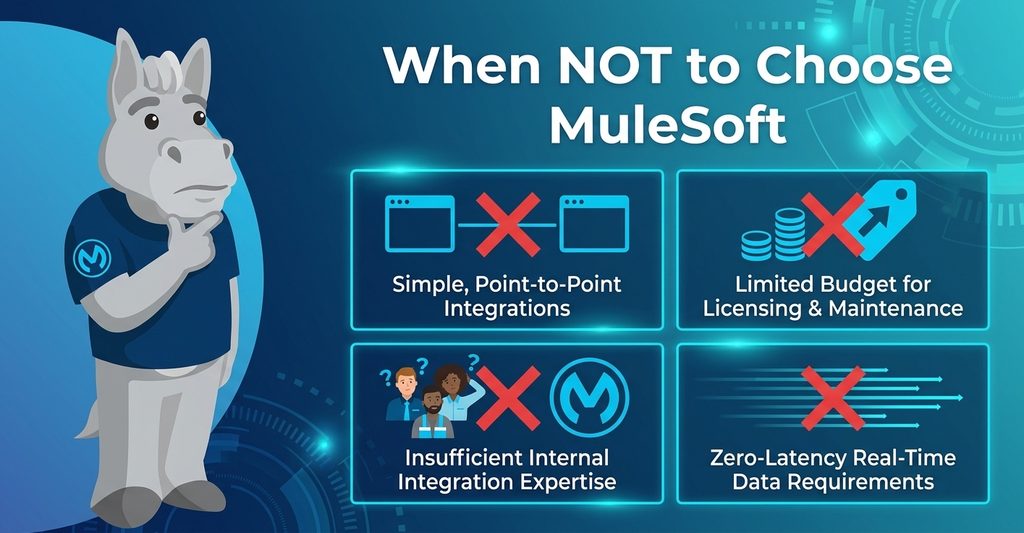
Three situations come up repeatedly where the honest recommendation is not to hire a MuleSoft integration partner at all.
When the workload does not need MuleSoft
Boomi frequently wins on connector breadth and low-code speed at lower total cost. Workato suits estates that are predominantly cloud software with moderate transaction volumes.
SnapLogic fits data-heavy and analytics-oriented pipelines better than API-management-heavy governance work. Each of those is a different job, and we have written the platform-by-platform version of this decision rather than compressing it here.
Resolving the platform question before the partner question saves a category of expensive rework. Choosing a partner first tends to lock in the platform by default.
When MuleSoft’s own delivery arm is the better route
MuleSoft’s first-party Professional Services and Catalyst engagements are a genuine alternative, not a synonym for partner work. They bring platform-native methodology directly from the vendor.
The trade-off is industry context. A partner working in your sector brings pattern recognition about your constraints that a platform-native team generally does not, and the fit depends on which of those two you are short of.
When enabling your team beats outsourcing
A Center for Enablement, combined with targeted training, can outperform an outsourced build where the organization intends to own integration long term.
The trade-off is honest and worth stating plainly. You start slower, you pay less over a five-year horizon, and you carry higher key-person risk if the people you trained leave.
Integration readiness for AI agents
Agent architectures changed what your integration architecture has to do, and most partner evaluation criteria have not caught up.
What agentic architectures demand
Agents that only need Salesforce data can operate inside the platform. Agents that need SAP inventory levels, legacy ERP order status, or third-party logistics tracking need the integration layer to expose those systems as agent-usable tools.
The Anypoint Platform addresses this through Agent Fabric. The MCP Connector turns external APIs into tools an agent can call, and the A2A Connector allows agents on different platforms to communicate. Agent Fabric is where the MCP Connector and agent-facing API governance meet.
The consequence for MuleSoft integration partner selection is direct. A partner working only inside Salesforce cannot reach non-Salesforce systems on day one, while a partner covering both platforms can.
What agent access does to your security posture
Autonomous consumers change the API security question. Endpoints that were safe under conventional API governance behave differently when an agent can call them under varied conditions.
Excessive data exposure and improper asset management move from housekeeping issues to live risks. Zombie and shadow APIs become reachable by something that will keep trying.
What to ask a partner about agent readiness
- Can you show integration work built for agent consumption
- How do you assess data readiness before an agent build starts
- How do you govern what an agent is permitted to reach
- What happens when an agent requests data it should not have
A MuleSoft integration partner without answers here is scoping the engagement you needed two years ago.
Frequently Asked Questions
Who are the best MuleSoft integration partners in 2026?
No single firm is best for every job. The market divides into global system integrators, Salesforce-ecosystem specialists, mid-market integration specialists, and offshore or nearshore delivery shops. Match the band to your estate size and enterprise integration governance obligations first, then verify individual firms through Salesforce Partner Finder rather than published rankings, since those rankings measure content marketing rather than delivery.
How much do MuleSoft integration services cost?
MuleSoft licensing runs a median of roughly $55,000 to $69,000 per year according to Vendr procurement data reviewed by Costbench and CheckThat, with a full range from about $10,000 to $259,000 and large enterprises reaching $250,000 to $600,000 or more. Delivery and managed support are separate bills. Specialist DataWeave staffing adds $150,000 to $200,000 per developer.
How long does a MuleSoft implementation take?
Focused, well-scoped work commonly completes in two weeks to four months. Multi-system programs with legacy dependencies run longer, and the limiting factor is usually the condition of your source systems rather than the integration build. A platform assessment establishes the realistic timeline before you commit to a delivery schedule.
Do I need a MuleSoft partner if I have in-house developers?
It depends on whether you have architects or builders. In-house developers can execute against a design, but API-led connectivity design, governance frameworks, and runtime topology decisions require MuleSoft-specific experience that general development skill does not cover. A Center for Enablement plus targeted training is a legitimate alternative if you intend to own integration long term.
How do I verify a MuleSoft partner’s certification claims?
Open the firm’s AppExchange consulting listing and note the certification count, then compare it against the same claim on the firm’s own website. Any disagreement between two properties the firm controls is a signal to treat its other numbers as unverified. Then ask for the split between developer, architect, and platform credentials rather than accepting an aggregate total.
What is the difference between a Salesforce partner tier and MuleSoft partner status?
Salesforce consulting tiers are earned on aggregate performance across the entire Salesforce portfolio. MuleSoft-specific partner standing is a separate designation. A firm can hold a high ecosystem tier while having delivered very little MuleSoft work, so verify the MuleSoft status independently rather than inferring it from a general Salesforce badge.
What happens to our data if the delivery team is offshore?
Ask where integration test data physically resides during development, and get the answer written into the statement of work rather than the proposal. For Canadian institutions this intersects with OSFI third-party risk expectations and Quebec’s Law 25 transfer requirements. Most partners ranking for this topic run offshore or nearshore delivery and have not documented a position.
What are the risks of a poorly delivered MuleSoft integration?
The expensive failures are architectural rather than technical. An integration architecture built only at the Experience API layer recreates point-to-point coupling, ungoverned APIs accumulate as security exposure, and undocumented builds become unmaintainable when the delivery team leaves. Removing a poorly built layer typically costs more than the original build. A readiness check surfaces these before they compound.
Where to start
This article argued for verification before commitment, and the same logic applies to how you engage a MuleSoft integration partner.
- If you have an existing MuleSoft estate and no clear picture of its condition, start with an assessment that produces a target-state architecture and roadmap rather than a build proposal
- If your concern is API exposure, particularly with agents in scope, start with a security audit against the OWASP API categories
- If the platform decision is still open, resolve that before selecting a MuleSoft integration partner
Request a MuleSoft Platform Assessment to establish where your estate stands, or review how the MuleSoft practice is structured before you shortlist anyone.