
Hiring a Salesforce consultant can provide strategic direction, help you make informed technology choices and help ensure your technology scales with your organization.
To hire a Salesforce consultant, first decide which of four models fits your project:
- An independent contractor
- A staff augmentation bench
- A scoped consulting partner
- An in-house administrator.
The right model depends on whether you are buying a person’s hours or a defined outcome. Then verify certifications against the people who will actually work on your project, ask for artifacts instead of references, and price the engagement on scope rather than hourly rate. Timing matters as much as selection.
The strongest signal that you need outside help is a change your current team has not done before.
If you plan to hire a Salesforce consultant, this guide covers when to look for one, who the options are, what to look for, and how to evaluate every candidate, from a freelancer to a Salesforce consulting partner, against the same standard.
When Is the Right Time to Hire a Salesforce Consultant?
Start with when you do not need one. Routine user management, report building, and small Flow changes belong to a Salesforce administrator, not consultant rates. Paying project rates for maintenance work is the most common overspend in the ecosystem, and a structured look at what your org actually needs will tell you which side of that line you are on.
The right time to hire a Salesforce consultant is when your team faces a change it has not done before. Five triggers cover most cases.
- First deployment or re-implementation
You are rolling out Salesforce for the first time, or replacing another customer relationship management (CRM) system. The decisions made in the first 90 days shape the platform for years.
- Multiple teams converging on one org
Sales, service, and marketing start sharing the same Account and Contact records. The data model now has to survive conflicting requirements, and design mistakes here multiply across every team.
- Fragmented data across systems
Customer records live in spreadsheets, a legacy CRM, billing, and an enterprise resource planning (ERP) system. Consolidating them is architecture work, not configuration work.
- A stalled or degraded org
Automation nobody documented, adoption in decline, reports nobody trusts. This job is remediation, and it rewards someone who has untangled orgs before.
- AI on the roadmap
Agentforce and Data Cloud amplify whatever data quality you have. Readiness work comes before agent work, every time.
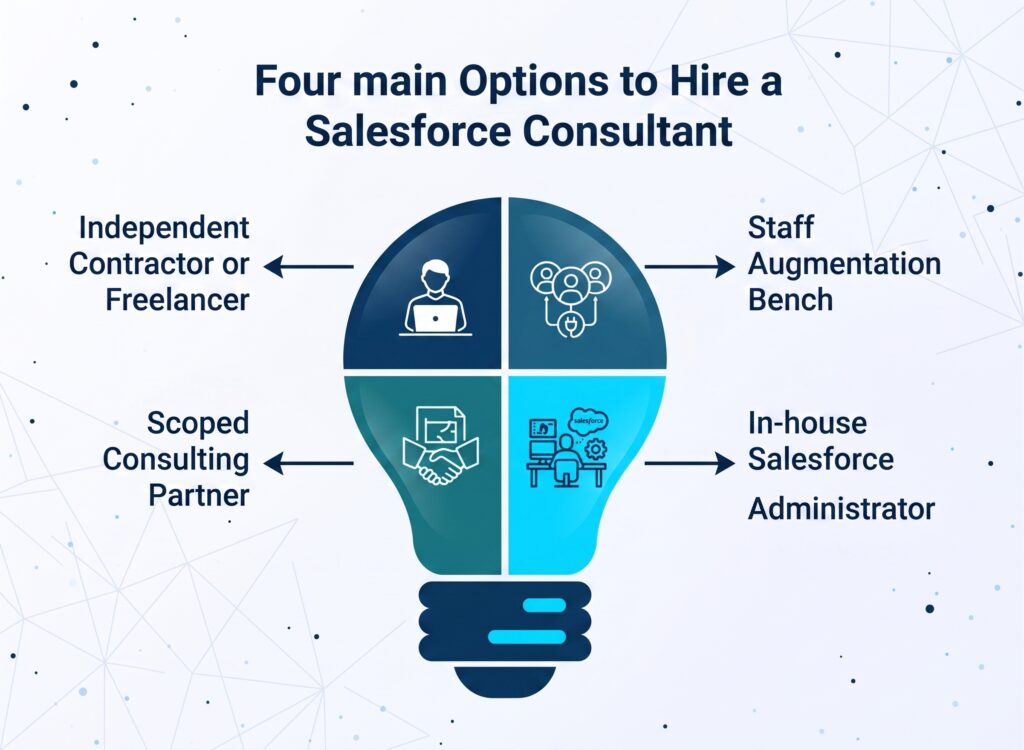
Hire A Salesforce Consult: Four Main Options
Every Salesforce consultant you find sells exactly one hiring model and presents it as the only one. Marketplaces sell freelancers at an hourly rate. Offshore benches sell hourly as well. Staffing firms sell placements. Salesforce consulting firms sell projects. Each model is different and it’s best to find the right one for your company’s situation.
Independent contractor or freelancer
An independent contractor is one named person, billed hourly or part-time, sourced through marketplaces or referrals. This model works best for narrow, well-defined tasks where someone on your team owns the outcome. The risk is concentration: one person, no bench, and no accountability beyond the individual.
Staff augmentation bench
A vendor supplies certified consultants from a bench, often offshore or nearshore, billed hourly. This model works when you have a capable internal team that needs extra hands. The trade is hidden in the structure: the vendor manages the people, but you manage the outcome. The rate looks low because the management burden is yours.
Scoped consulting partner
A Salesforce consulting partner takes accountability for a defined outcome at a fixed price or capped budget. Salesforce implementation partner and consulting partner mean the same purchase: a firm, not a person. This model fits transformations, integrations, and remediation, where the deliverable matters more than the hours. It costs more per hour, and quality varies enormously between firms, which is exactly what the evaluation sections below are built to solve.
In-house Salesforce administrator
A full-time employee who runs the platform continuously. An admin is not a substitute for the other three models, and none of them substitutes for an admin. Most growing companies need an admin plus one of the above at different stages.
Where do you find candidates? Start with the Salesforce AppExchange consultant directory, ask your Salesforce Account Executive for a shortlist, check independent review directories, and ask peers who have shipped similar projects.
| Your situation | Right model | Cost basis | What breaks if you pick wrong |
|---|---|---|---|
| Defined small task, internal owner exists | Contractor | Hourly | You overpay a firm for commodity work |
| Capable team, not enough hands | Staff augmentation | Hourly | Outcome drifts because nobody owns delivery |
| Defined outcome, cross-system complexity | Scoped partner | Fixed or capped | A contractor or bench lacks accountability and architecture depth |
| Continuous upkeep and user support | In-house admin | Salary | You pay consultant rates for admin work |
Who You Are Actually Hiring: Consultant, Admin, Developer, Architect
A Salesforce consultant translates business requirements into platform design decisions. That covers process mapping, data model design, automation strategy, cloud selection, and rollout planning. The title gets applied loosely across the market, so pin down the role behind it before you compare rates, and hold integration-heavy roles to their own evaluation criteria.
Salesforce consultant vs administrator
A consultant designs and changes the system for a defined outcome, then leaves. An administrator runs and maintains the system continuously as an employee. Mixing these up is expensive in both directions: consultant rates for admin work overpay by two to four times, and admin skills applied to architecture decisions often force a rebuild later.
Consultant vs developer
A consultant makes design decisions. A developer writes Apex, builds custom applications, and works at the API layer. Many buyers assume they need a developer when they need an admin or a consultant. The platform itself points the same way: Flows and AppExchange solutions come before custom code, and a developer is the right hire for API-level work, not for automation an admin can build.
Solution architect and Certified Technical Architect
The Salesforce Certified Technical Architect (CTA) credential marks the senior tier for multi-cloud, integration-heavy, or regulated programs. If your project spans several clouds, middleware such as MuleSoft, and external systems, this is the skill level your shortlist should include.
What to Look For When Hiring a Salesforce Consultant: Certifications, Evidence, and the Experience
Certifications are a must when looking for a Salesforce consultant. The Administrator and App Builder certifications prove platform mechanics. Consultant-track certifications, such as Sales Cloud Consultant or Service Cloud Consultant, prove domain configuration. Architect certifications prove design judgment at scale. Match the certification track to the clouds in your org, and treat anything beyond that as marketing.
Watch the switch vendors pull between individual certifications and firm credentials. A firm advertising 400 or more certifications across its bench is telling you about the bench, not about your project team. The question that cuts through it: which named people will work on my project, and what have those specific people shipped?
Then rank evidence over experience. Get specific case studies when possible. For example, a story with system names and scale tells you what the firm can actually do, and it is the evidence standard worth holding every firm to. “Hundreds of happy clients” tells you nothing.
Ask for artifacts next: a sample architecture diagram, a project plan, an anonymized deliverable. A firm that cannot show you how it works is asking you to trust a pitch. Finish with references you choose from their client list, not references they curate for you.
One more filter for multi-cloud orgs. A consultant who has only shipped Sales Cloud will build things that break at the boundaries between Sales, Service, Marketing, and Data Cloud, and integration platforms like MuleSoft sit outside their experience entirely. Cross-cloud scars matter more than any certification count.
What Does It Cost to Hire a Salesforce Consultant?
Freelancers typically bill $50 to $150 per hour. Certified consulting firms commonly run $100 to $300. Senior architects and specialists reach $200 to $400. Large system integrators charge $250 to $500 or more.
For context, ZipRecruiter salary data puts the average employed Salesforce consultant near $57 per hour, which shows how much of a consulting bill is firm overhead, bench depth, and accountability rather than the individual’s pay.
| Provider tier | Typical 2026 hourly range | Best fit |
|---|---|---|
| Freelancer or contractor | $50 to $150 | Narrow, well-defined tasks |
| Certified consulting firm | $100 to $300 | Scoped projects with defined outcomes |
| Senior architect or specialist | $200 to $400 | Multi-cloud, integration-heavy design |
| Large system integrator | $250 to $500+ | Global programs with heavy governance |
How to Evaluate: Nine Questions and the Artifacts to Ask For
For every candidate, from freelancer to global firm, here are nine questions you should ask. Strong answers share one trait: they are specific.
- Who exactly will work on this project, and will the same people finish it? A strong answer names individuals and addresses continuity directly. Senior people selling while juniors deliver is a known failure mode.
- Show me a similar project with system names, scale, and the measured result. Vague summaries are a no.
- What artifacts can you share before we sign? Ask for a sample architecture diagram, a project plan, and an anonymized deliverable.
- How do you scope? A quote produced without discovery questions about your org is a guess. Serious firms often start with a structured assessment process before they price anything.
- What is in the statement of work (SOW), and what is explicitly out of scope? A vague SOW is a blank check.
- Tell me about a recent scope change and how you handled it. Then ask to speak with that client.
- What happens after go-live? Expect a defined hypercare window, commonly 30 to 60 days, with response-time commitments in writing and a named owner for tickets in month three.
- How will you train my team so we are not dependent on you? A partner whose revenue model relies on your dependency is a budget risk.
- If AI is on our roadmap, how does this project set up Agentforce, and what would you fix first? The strong answer starts with data and integration readiness, and it matches how readiness work sequences before any agent gets built.
The meta-criterion sits above all nine. The best consultants push back on your framing during the sales process. A vendor who agrees with everything you say is selling hours, not judgment.
Common Mistakes and Red Flags
Paying consultant rates for admin work. The role mismatch runs both ways. Consultant rates on maintenance tasks drain budget, and admin-level skills on architecture decisions create rework.
Hiring on rate instead of total cost. The cheapest bid rarely delivers the lowest total cost. Ripping out a poorly built layer costs two to three times the original build, a pattern documented across enterprise integration engagements.
Signing a vague SOW. No deliverables, no milestones, and no out-of-scope list means the change orders write themselves.
Senior people sell, juniors deliver. The antidote is question one above: named individuals, verified before signature.
Skipping the org assessment. Scoping against an unexamined org guarantees mid-project surprises. A two-week org review surfaces what an RFP never will, and it tells you what you are actually buying help for before any vendor prices it.
Where Incepta Solutions Fits
Incepta Solutions is a Toronto-based Salesforce consulting partner, and this page’s own standard applies to us like everyone else. So here is the specific, checkable version.
Incepta holds Premier Partner status with both Salesforce and MuleSoft, with more than a decade of delivery across banking, telecom, CPG and retail, logistics, and manufacturing. That pairing matters for one reason: the work that stalls Salesforce projects usually lives in the integration layer, and Incepta wires Salesforce into the rest of the estate through MuleSoft, Boomi, Workato, and SnapLogic rather than stopping at the org boundary.
Run us through the nine questions. The first artifact you will see is an assessment scorecard, not a slide deck, and it is yours to keep whichever partner you choose.
Scope It Before You Staff It
This guide told you to demand evidence, artifacts, and scope before signing anything. Hold Incepta to the same standard.
- The Salesforce Platform Assessment surfaces the tech debt, data quality gaps, and integration issues that determine what kind of help you actually need.
- Every assessment produces artifacts your team keeps, whichever hiring model you choose afterward.
- Whether the job is consolidation, extension, integration, remediation, or AI-enablement, the assessment scopes it before you staff it.
Book a complimentary two-hour discovery session with a Salesforce subject matter expert, and walk in with the nine questions from this guide
Frequently Asked Questions
How much does a Salesforce consultant cost per hour?
Salesforce consultants bill $50 to $150 per hour as freelancers, $100 to $300 at certified firms, and $200 to $500 or more at the architect and system integrator tier, based on published 2026 rate data. The hourly rate is the smallest lever on total cost. Scope, data quality, and cloud count drive the final number, which is why modeling the numbers before you commit beats comparing rates.
Should I hire a freelance Salesforce consultant or a Salesforce consulting partner?
Task shape decides, not budget alone. A freelance Salesforce consultant fits narrow, well-defined work with an internal owner. A Salesforce consulting partner fits defined outcomes with cross-system complexity, because the firm carries accountability, bench depth, and a blended hourly rate that reflects both. If the deliverable matters more than the hours, buy the outcome, and hold the firm to a written evidence standard before signing.
Do I need a Salesforce consultant or just an admin?
Apply the maintain-versus-change test. If the work is running the platform, supporting users, and small improvements, hire or train a Salesforce administrator. If the work is a change your team has not done before, such as consolidation, integration, or AI-enablement, hire a Salesforce consultant for the project and keep the platform’s ongoing customer view in admin hands.
What certifications should a Salesforce consultant have?
Match the certification track to your clouds. Administrator and App Builder prove platform mechanics. Sales Cloud Consultant and Service Cloud Consultant prove domain configuration. Architect credentials, up to Salesforce Certified Technical Architect, prove design judgment for multi-cloud programs. Certifications set a floor. Verify them for the named people on your project, then weight shipped work over certificate counts.
How long does a Salesforce consulting engagement take?
Focused scoped work often lands in four to eight weeks. Multi-system programs run four to six months or longer from pilot to scaled rollout. Data readiness is the usual variable that stretches timelines. A short assessment phase at the front of the engagement compresses the rest, because it removes the surprises that stall projects mid-flight.
Where do I find a Salesforce consultant?
Start with the AppExchange consultant directory, then ask your Salesforce Account Executive for a shortlist, check independent review directories, and ask peers who have shipped similar work. The source matters less than the screen. Run every candidate through the same nine evaluation questions, and ask each one what they would assess before quoting.
Can I implement Salesforce without a consultant?
Yes, with a solid technical foundation, clean data, and time. Small teams with simple processes deploy Salesforce on their own regularly. The four-question test is whether multiple teams share the org, whether data is fragmented across systems, whether the org has degraded, and whether AI is on the roadmap. Two or more yes answers put you in scoped-partner territory rather than do-it-yourself territory.