
MuleSoft for financial services means using Anypoint Platform as the layer between your core banking system and everything else. That includes your CRM, your digital channels, and outside services like payments, ID checks, and fintech partners. It’s the plumbing that lets one integration layer serve every system you add later.
The MuleSoft Accelerator for Financial Services gives you API specs and templates for seven use cases plus BIAN assets. Its latest release is version 1.12 from March 12, 2025. It names only two cores and leans on Salesforce products, so treat it as a reference design that your architects still have to adapt.
The decision most banks make by accident is where integration data actually lives. That’s why a review of your current MuleSoft setup pays off early.
What MuleSoft Does Inside a Bank or Credit Union
To see what MuleSoft for financial services does, start with the three kinds of systems every bank runs. Your core banking platform is the system of record, holding official balances and transactions. Your CRM and channels are systems of engagement, where people work. Naming those roles is one of the decisions to settle before you extend Salesforce into a bank.
MuleSoft is the third piece. It moves data between the core, the CRM, and everything else, so each system doesn’t need its own direct link to every other one. That’s what people mean by core banking integration, and it’s the job of an integration layer you build once and reuse.
So which is better, MuleSoft or Salesforce? Neither, because they do different jobs. Salesforce Financial Services Cloud, now also called Agentforce Financial Services, is where people work with clients. MuleSoft for financial services is how that CRM gets live data from the core, which the build-level guide to Financial Services Cloud covers from the Salesforce side.
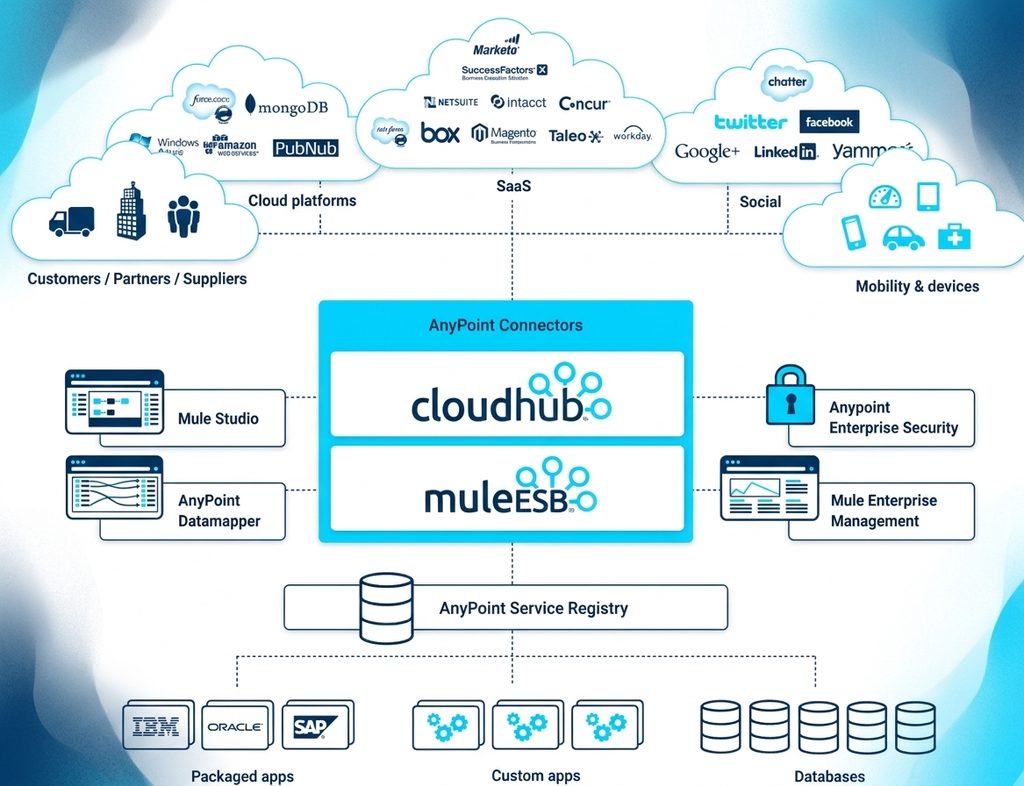
Most MuleSoft banking programs use API-led connectivity. MuleSoft’s documentation describes it as three layers of APIs, each with one job. This design is why layered APIs replaced the old service bus, and here’s how the layers map to a bank:
| Layer | What it does | Banking example |
| System API | Opens up one system’s data, with no business rules | Accounts and balances from the core |
| Process API | Combines systems and applies business rules | “Open a deposit account”: ID check, screening, then core account creation |
| Experience API | Shapes data for one user or app | Mobile banking, the advisor desktop, or a fintech partner |
The payoff is reuse. Once a System API exposes core accounts, every new channel can use it without touching the core again. MuleSoft says Invesco cut development hours by 92%, a vendor-published customer quote worth reading as a direction, not a promise. Reuse is also what connecting the systems your client data is spread across depends on.
What’s Actually in the MuleSoft Accelerator for Financial Services
The MuleSoft Accelerator for Financial Services isn’t a separate product you license. MuleSoft describes its accelerators as API specifications, implementation templates, reference architectures, and documentation, built so you can change the patterns, mappings, and endpoints. You need an Anypoint Platform login to open the assets in Anypoint Exchange, the same way you’d reach anything your team publishes for reuse.
MuleSoft’s financial services page says Exchange assets like these are included with your subscription. So the MuleSoft Accelerator for Financial Services costs nothing extra, but you still pay for the platform and any Salesforce products a use case needs. That licensing math belongs in the questions to ask before you scope a MuleSoft program.
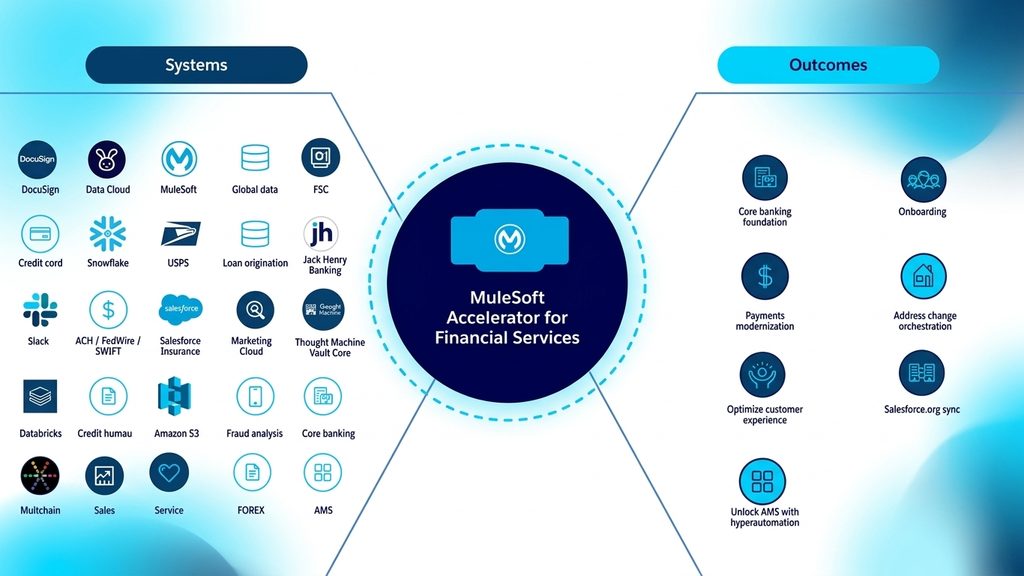
Here’s what the MuleSoft financial services accelerator includes in version 1.12, per MuleSoft’s documentation. One use case feeds Data Cloud, so it helps to know what changed when Data Cloud became Data 360.
| Use case | What it does | What it assumes you have |
| Core banking foundation | Builds a customer 360 view of financial accounts | Any core, or Jack Henry SilverLake, or Thought Machine Vault |
| Onboarding | Supports loan origination in banking and account opening in wealth | Financial Services Cloud and a document system |
| Payments modernization | Handles many payment types for banks and credit unions | Payment systems and your core |
| Address change orchestration | Updates everything a postal address change touches | Banking and insurance versions |
| Optimize customer experiences | Sends data into Data Cloud and shows insights to service reps | Data Cloud and Service |
| Salesforce org sync | Keeps customer data in sync across several Salesforce orgs | Financial Services Cloud, Sales Cloud, Service Cloud |
| Unlock AMS for insurance brokers | Shows agency management system policy data in the CRM | An AMS and a CRM |
| BIAN assets | BIAN-compliant API specs and templates for any use case | Nothing specific |
BIAN stands for the Banking Industry Architecture Network, a standard way to describe banking services. The accelerator ships BIAN-compliant assets, but adopting BIAN is a design choice, not a rule. Many banks keep their own data model, which is the kind of call solid enterprise architecture work settles early.
The latest release, 1.12, made the assets compatible with Java 17. Setup depends on the use case. MuleSoft’s prerequisites page lists guides for Anypoint MQ, RPA, Data Cloud, Financial Services Cloud, and Marketing Cloud. That list shows how much of the value sits on the Salesforce side of the connection.
Where the MuleSoft Accelerator for Financial Services Stops
Most content about the MuleSoft Accelerator for Financial Services describes what it does. Few pages say what it doesn’t do, and that’s what you need before you plan around it. Here are four limits worth knowing, each one a reason to run a check of what’s really in an existing MuleSoft estate first.
It Names Only Two Cores
In the MuleSoft Accelerator for Financial Services, the core banking foundation use case has templates for Jack Henry SilverLake and Thought Machine Vault. Every other core starts from the generic “unlock any core” template. That’s still useful, but your team writes the DataWeave mappings for your own core, which is where our Temenos and core system integration work usually begins.
For MuleSoft banking projects on FIS, Fiserv, Temenos, or a homegrown mainframe core, plan for core banking integration as real build work. The accelerator gives you the shape of the API, not the connection to your system. This is also the point to confirm MuleSoft fits the job at all, which is the platform-fit question to settle first.
Templates Aren’t Compliance Controls
Some content online calls the MuleSoft Accelerator for Financial Services “compliance-ready.” MuleSoft’s own documentation describes use cases and templates, not compliance controls. Encryption, access policies, audit logs, and data retention are still your team’s job. An audit of exposed endpoints and policy gaps is how you find what’s missing.
Most of the Value Assumes Salesforce
Several MuleSoft Accelerator for Financial Services use cases expect Financial Services Cloud, Data Cloud, or Marketing Cloud. If your engagement layer isn’t Salesforce, you mostly get the BIAN assets and the generic core template. That’s fine, but set expectations early. It’s also a good test of what separates an integration partner from a configuration shop.
The Last Release Was March 2025
Version 1.12 is the latest release in the docs. Check Anypoint Exchange for what’s current before you build around a template, and plan to own any template you adopt. We’ve seen a fintech that couldn’t tell if its MuleSoft setup was working because the people who designed it had moved on and nothing was written down.
The takeaway for MuleSoft for financial services teams is simple. Treat the MuleSoft financial services accelerator as a reference design and a starting backlog, not a finished build. That mindset keeps your team from inheriting templates it doesn’t understand, which is the trap a structured onboarding package avoids.

Six Use Cases Banks and Credit Unions Build First
These are the MuleSoft banking patterns we see most often. Credit unions build the same things with smaller teams, and the accelerator’s payments use case names banks and credit unions together. Each one below follows API-led connectivity, which is why enterprises keep choosing MuleSoft for integration.
1. Core Banking Foundation and Customer 360
Every MuleSoft for financial services program should start with System APIs over your core. Every later use case reuses them, so they’re the most valuable APIs you’ll build. They give service reps a customer 360 view of accounts and balances without logging into the core. That’s the goal of a single customer view built on Salesforce.
Most core banking integration traffic is reads. Service views need fresh data, while history can load in batches. We won’t repeat that breakdown here, since our guide already covers how each system should sync, real-time or batch. This maps to the MuleSoft Accelerator for Financial Services templates for core banking and Data Cloud.
2. Customer Onboarding and KYC Orchestration
In MuleSoft for financial services builds, customer onboarding is mostly orchestration. A Process API calls your ID vendor, runs screening, reads uploaded documents, opens the core account, and updates the CRM. It also owns retries, so a slow vendor can’t leave a half-opened account. That’s a big part of cutting manual steps out of KYC and account opening.
The journey design, like which steps need human review, is a business decision that comes first. The accelerator’s onboarding use case covers loan origination in banking and account opening in wealth, so it’s a useful reference. Document intake is often the slowest step, and it’s where extracting data from uploaded files saves the most time.
3. Payments Modernization
Payments modernization usually means putting many payment types behind one Process API. Your channels call one API, and MuleSoft routes each payment to the right system. That keeps new payment options from turning into new point-to-point links, a pattern our banking and finance practice builds around.
Two things break payment builds most often. The first is idempotency, meaning a retry must never send the same payment twice. The second is reconciliation, so every payment can be traced end to end. Both belong in your tests, and unit testing habits for Mule apps catch most of these problems before go-live.
4. Open Banking and Fintech Partner APIs
In MuleSoft banking, partner-facing work lives in Experience APIs, with rate limits and consent checks at the gateway. The rules are still moving in both countries. In the US, the CFPB’s Section 1033 rule is paused by a court and under reconsideration. While you wait, start with locking down the APIs partners can reach.
In Canada, the Consumer-Driven Banking Act received Royal Assent on March 26, 2026, with the Bank of Canada overseeing participants and payment initiation targeted for mid-2027. Design open banking APIs so a new standard can be added without rebuilding your System APIs. That’s the API-led connectivity principle behind our MuleSoft integration services.
Partner APIs can scale across many institutions. We built a single MuleSoft API that connected a Canadian appraisal management company’s portal to banks in Central America. The team mapped more than 200 data fields across eight enterprise systems and went live in four months, as the appraisal integration case study shows.
5. Mergers and Multi-Org Consolidation
Acquisitions bring a second core, a second CRM, or both. MuleSoft lets the old and new systems run side by side while you move customers over. The accelerator’s org sync use case keeps data in step across several Salesforce orgs. A team that works on both sides of the Salesforce connection can run that transition.
Plan these moves in waves, one product line or region at a time. That way one late system doesn’t hold up the rest. The same phased thinking worked when we led a move of more than 70 APIs and applications with no service disruption.
6. Insurance and Wealth
Insurers use the accelerator’s agency management system template to show broker policy data in the CRM. The address change use case also has an insurance version, since one address change sets off updates across policy systems. These are common insurance integration patterns for carriers and brokers.
Wealth firms focus on client onboarding and on getting custodian data into the advisor’s desktop. The goal is wealth client data in one view, so advisors stop switching between systems to answer one question.
Where Your Integration Data Lives: The Decision Banks Make by Accident
Data residency is where many MuleSoft for financial services programs quietly go wrong. MuleSoft splits the platform into two parts. The control plane is where Anypoint keeps management data and metadata. The runtime plane is where your Mule apps actually run and process data. Salesforce products have their own rules, covered in where each Salesforce product stores your data.
Here’s the line most teams miss. MuleSoft’s docs state that a runtime region is independent of control plane data residency. Deploying to a Canadian runtime region from US Cloud does not give you Canada Cloud. This matters most for cross-border banks, and it’s a question an architecture review should answer in writing.
MuleSoft offers several control planes, including US Cloud, EU Cloud, Canada Cloud, Japan Cloud, and Government Cloud. There’s also a customer-hosted Private Cloud Edition for full control, though some components aren’t supported there. CloudHub 2.0 runs in regions that include Canada (Central), so you can match the runtime to your rules when moving an existing estate onto CloudHub 2.0.
| Option | Where Mule apps run | Who runs the infrastructure | Fits when |
| CloudHub 2.0 on US Cloud or Canada Cloud | A MuleSoft-managed region you pick | MuleSoft | You want a managed runtime and your rules are met by the region plus the control plane |
| Runtime Fabric | Your data center or your own cloud account | You, with MuleSoft handling orchestration | Data must stay inside your network or a specific account |
| Hybrid standalone runtime | Your own servers | You, with MuleSoft handling management | You have a small footprint or an existing on-premises estate |
| Private Cloud Edition | Your environment, including the control plane | You | You need full control and can live without some components |
Runtime Fabric is the option to look at when data must stay in your own environment. Salesforce’s Trailhead calls it well suited to strict security and regional data rules. We’ve covered why some teams run Mule apps on their own containers, and what it looks like to run Runtime Fabric inside a company’s own AWS account.
The same platform doesn’t always mean the same features. MuleSoft’s docs note that some CloudHub 2.0 features vary by control plane. For example, deleting the default outbound network route isn’t available in Canada Cloud. Check every feature you rely on against the control plane you pick, ideally during the discovery stage of an implementation.
Regional hosting is growing. Salesforce brought MuleSoft to Hyperforce in Canada in January 2025. Don’t forget the data that sits outside your apps, too. Ask where Anypoint MQ queues, Object Store, and logs live, because each one holds client data that a security review of your API estate should account for.
Governing APIs That Carry Client Data
In MuleSoft for financial services work, every API that moves client data is in audit scope. API Manager policies, like client authentication, rate limits, and IP rules, control who can call what. Anypoint Monitoring gives you the record of what happened. Together they’re your evidence trail, and they should be set up before the first wave of integrations goes live.
Versioning matters just as much. Without a retirement policy, old API versions pile up. Nobody owns them, but auditors still find them, and attackers can too. Write down how you version, announce, and retire each API, and have an audit of your MuleSoft estate confirm nothing slipped through.
Here’s what that looks like in practice. We ran an API security assessment for a Canadian point-of-sale financing company. The published sample findings list 65 APIs, 15 types of data, and 33 issues, split between 17 posture problems and 16 runtime problems. You can read what the API security review found at that fintech, including the roadmap it produced.
Getting Core Systems Ready for AI Agents
AI agents are only as useful as the systems they can reach. MuleSoft for financial services is now pitched around AI and agents by MuleSoft itself, and the reason is practical. An agent that can’t see core balances or open a case can’t do much for a client, which is how agents reach data that lives outside Salesforce.
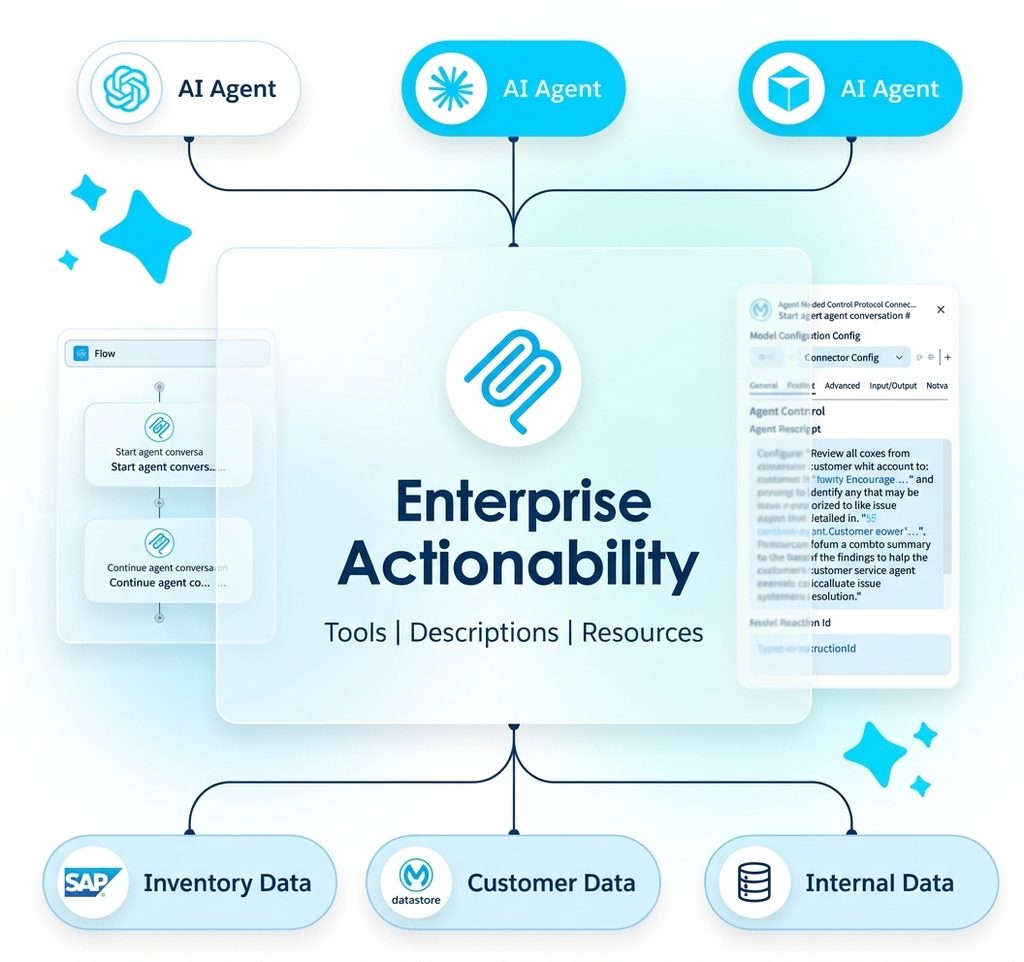
The System APIs you’ve already built for core data can become agent tools through MuleSoft’s Model Context Protocol (MCP) support. Agent Fabric then governs which agents can call which APIs. We’ve laid out four steps to make existing APIs safe for agents, starting with a catalog of what you already have in Anypoint Exchange.
Banks carry one extra risk with agents. An agent that can call a payments Process API needs much tighter limits than a human-facing app. Give each agent the smallest set of actions it needs, log everything, and keep a person in the loop for money movement. Our scorecard covers permissions and human review before agents touch client data.
Five Questions to Ask Before You Hire for MuleSoft Financial Services Work
General partner checks still apply, and we’ve covered them in the full checklist for evaluating MuleSoft partners. For banks and credit unions, add these five questions. Each one has an answer you can check, which is what separates a real track record from a pitch:
- Which cores have you integrated, and did you start from the accelerator or from scratch?
- Which control plane and runtime option did you use for a regulated client, and why?
- Can you show us a Process API that runs customer onboarding across an ID vendor, screening, and the core?
- How do you version and retire partner-facing APIs?
- What did the client own and run on their own after go-live?
If a partner can’t answer the second question clearly, that’s a warning sign. Data residency is where MuleSoft for financial services projects get expensive to fix later. For a longer list, use these 25 questions to ask before an integration project starts.
How Incepta Helps With MuleSoft for Financial Services
We help banks, credit unions, insurers, and wealth firms build integration that holds up under audit. Here’s where a MuleSoft practice built around regulated work usually starts, based on where you are today:
- You already run MuleSoft: start with an assessment of what’s built and where it runs, then get a fix-first list.
- You need core banking integration: we build System APIs over your core, whether or not the accelerator names it.
- You’re worried about exposure: we audit APIs that carry client data and tighten policies before your next review.
- You’re adding agents: we make core APIs agent-ready with limits and logging in place.
Want to see how this fits your institution? Explore our banking and finance work, or talk through your scope with our team.
Frequently Asked Questions
What is MuleSoft used for in financial services?
MuleSoft for financial services is the integration layer between your core banking system, your CRM, your channels, and outside partners. It uses API-led connectivity, so each new channel or partner doesn’t need its own direct link to the core. Banks use it for customer 360 views, onboarding, payments, and open banking, the patterns behind our banking solutions.
Is the MuleSoft Accelerator for Financial Services free?
The MuleSoft Accelerator for Financial Services is included with your Anypoint subscription at no extra cost. You need an Anypoint Platform login to open the assets. You still pay for the platform and for any Salesforce products a use case assumes, like Financial Services Cloud or Data Cloud. Our partner guide explains what MuleSoft programs typically cost.
Which core banking systems does the accelerator support?
The MuleSoft Accelerator for Financial Services names two cores: Jack Henry SilverLake and Thought Machine Vault. Every other core, including FIS, Fiserv, and Temenos, starts from the generic “unlock any core” template. That makes core banking integration real build work for your team or partner, which is the core integration work banks hand to a specialist most often.
Which is better, MuleSoft or Salesforce?
MuleSoft and Salesforce aren’t competitors, because they do different jobs. Salesforce, including Financial Services Cloud, is where your staff work with clients. MuleSoft connects Salesforce to your core, payment systems, and partners so that work runs on live data. Most banks that use one end up needing both, which is why Salesforce and MuleSoft integration services are often bought together.
Can we keep MuleSoft data in Canada?
Yes, but a Canadian runtime region alone isn’t enough, because runtime region and control plane residency are separate. To keep both in Canada, use the Canada Cloud control plane with a Canadian CloudHub 2.0 region, or run Runtime Fabric in your own environment. Then check where queues and logs live too, which a CloudHub 2.0 migration plan should spell out.
Is MuleSoft still in demand in 2026?
MuleSoft is still investing in financial services and regulated markets. Its financial services page now centers on AI agents, and Salesforce brought MuleSoft on Hyperforce to India in May 2026 for local data residency. It remains a strong fit for banks with complex cores and strict governance, for the reasons in this look at MuleSoft’s benefits for enterprises.
Are companies moving away from MuleSoft?
Some companies with a few simple, cloud-only integrations do move to lighter tools to save money. Banks with complex cores, many channels, and strict audit needs usually get more from MuleSoft, because reuse and governance matter more as systems grow. If you’re weighing that trade-off, read when a lighter iPaaS makes more sense before you decide.
Does MuleSoft work for credit unions?
Yes. MuleSoft for financial services isn’t only for big banks, and the accelerator’s payments use case names credit unions. Small credit union teams gain the most from reusable System APIs, since they can’t rebuild the core connection for every channel. Start small, with one pilot API over the core, the way a four-week onboarding package is designed to work.